Religion and People in Uttarakhand
Religion and People in Uttarakhand
Religion and People in Uttarakhand
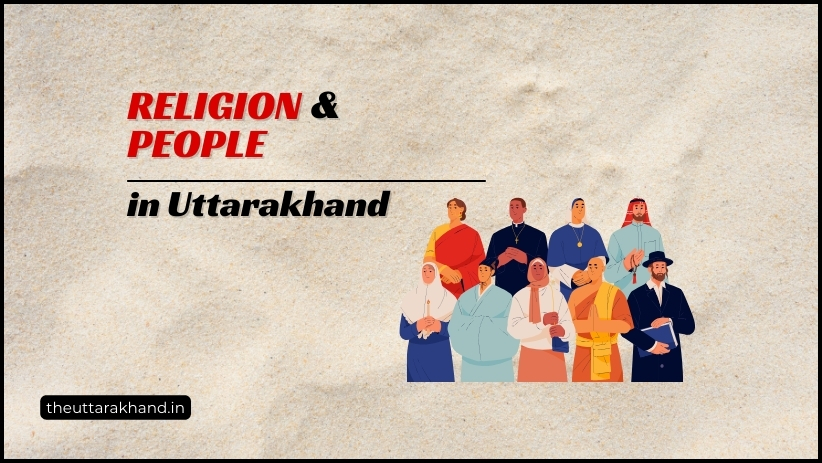
Religion and People in Uttarakhand : Uttarakhand, located in the foothills of the Himalayas, is often called the “Land of Gods” due to the many Hindu temples and pilgrimage sites located across the state. Hinduism is the most widely practiced religion, but there are followers of other faiths as well. The people of Uttarakhand, known as “Paharis”, consist of various ethnic groups and tribes with their own unique cultures and traditions.
Hinduism
Hinduism is overwhelmingly the dominant religion in Uttarakhand, practiced by about 83% of the population. Some of Hinduism’s holiest sites like the Char Dham (four pilgrimage sites) – Badrinath, Kedarnath, Gangotri, and Yamunotri – are located in the state.
Deities and Temples
Some of the most revered deities with major temples in Uttarakhand include:
- Badrinath: Dedicated to Lord Vishnu, this temple in Chamoli district is one of the Char Dham sites. The idol of Lord Vishnu is made of black stone and the temple architecture demonstrates a mix of styles from different eras.
- Kedarnath: This ancient temple dedicated to Lord Shiva is located in Rudraprayag district and is also part of the Char Dham. The inner walls of the temple sanctum are adorned with figures of various deities and scenes from mythology.
- Rudranath: The famous Swayambhu (self manifest) temple devoted to Lord Shiva lies amidst thick deodar forests in Chamoli district.
- Tungnath: The highest Shiva temple in the world at an altitude of 3,680 m, Tungnath temple lies close to Chopta in Rudraprayag district.
- Jageshwar: Located near Almora, this complex contains over 100 small stone temples from the 8th to 12th century AD, dedicated mostly to Lord Shiva. Intricate carvings depicting various deities adorn the temple walls.
Apart from these, many localized Hindu deities are also worshipped like Golu Devta, Nanda Devi, Kail Bisht, Bholenath, Hariyali Devi, etc.
Sacred Sites
The mountainous terrain of Uttarakhand is dotted with several sacred lakes, mountain peaks, confluences and forests that are significant in Hindu mythology:
- Hemkund Sahib: A Sikh pilgrimage center located in Chamoli district at an elevation of 4,600 m which as per tradition was the meditation spot of Guru Gobind Singh.
- Valley of Flowers: Believed to be the place where Hanuman collected the Sanjeevani herb to revive Lakshmana as mentioned in the Ramayana.
- Panch Kedar: The five sacred temples dedicated to Lord Shiva – Kedarnath, Tungnath, Rudranath, Madhyamaheshwar and Kalpeshwar.
- Panch Prayag: The five sacred river confluences – Vishnuprayag, Nandaprayag, Karnaprayag, Rudraprayag and Devprayag.
- Adi Kailash: A sacred mountain near Gupt Kashi village in Pithoragarh district, it is revered for its striking resemblance to Mount Kailash in Tibet.
Festivals and Events
Uttarakhand celebrates all major Hindu festivals. Some state specific festivals and events include:
- Khatarua: Marking the start of the New Year in Kumaon region, it is celebrated 15 days after Diwali.
- Harela: Coinciding with the arrival of monsoon, people plant trees and crops to celebrate Harela.
- Nanda Devi Raj Jat: The Nanda Devi idol is taken on a 3-week pilgrimage across Kumaon region once every 12 years.
- Purnagiri Mela: Every year devotees gather at the Purnagiri temple near Tanakpur to offer prayers to Goddess Purnagiri.
Caste System
The hill people are divided into two major groups:
- Rajputs: Traditionally warriors, landowners and rulers belonging primarily to the Khas community. This group enjoys high status in the caste hierarchy.
- Brahmins: Priests, scholars and advisors also belonging majorly to the Khas community. Though less in number than Rajputs, Brahmins have an influential position in society.
Other groups like scheduled castes, scheduled tribes and immigrant communities form the rest of the caste structure. But economic standing rather than caste is the primary social differentiator here.
Other Religions
Islam
After Hinduism, Islam is the second largest religion comprising over 14% of Uttarakhand’s people. Most Muslims live in the plains districts of Udham Singh Nagar and Haridwar.
Important Muslim pilgrimage sites:
- Piran Kaliyar Sharif: The dargah of Alauddin Ali Ahmed Sabir Kalyari located in Roorkee, it is among the most revered Islamic shrines in India.
- Jwalpa Devi: This syncretic shrine located near Pauri town is sacred to both Muslims and Hindus.
Sikhism and Christianity
Other major religions include Sikhism (2.4%) and Christianity (0.4%). Sikhs live mostly in Dehradun while the Christian population is concentrated in cities like Dehradun and Nainital.
Some prominent religious sites of these faiths:
- Gurudwara Nanakmatta Sahib: One of the holiest Sikh shrines associated with Guru Nanak Dev, it lies in Udham Singh Nagar district.
- St. John’s Church: Established in 1844, this iconic Anglican Church lies at the Mall Road in Mussoorie.
Buddhism
With a following of about 0.2%, Buddhism has influence mainly owing to Uttarakhand’s proximity to Tibet and Ladakh.
Jainism
Only 0.1% of people follow Jainism, concentrated mostly around Dehradun and Udham Singh Nagar.
Tribes and Ethnic Groups
Kumaonis
The dominant community native to Kumaon division. They have Mongoloid facial features hinting at their Kirati ancestry. Kumaonis mostly speak the Kumaoni language and are well regarded for their martial traditions.
Garhwalis
The original inhabitants of Garhwal region, speaking the Garhwali language. Generally of Indo-Aryan descent, Garhwalis too have a proud history of bravery and their pahadi culture is famous across India.
Jaunsaris
A major tribal group living in Jaunsar-Bawar region of Dehradun and Uttarkashi districts near Himachal border. Their culture is very distinct including unique forms of music and dance.
Bhotiyas
Comprising several tribal communities like Tolchas, Marchas, Bukshas etc. native to northern border areas. They exhibit clear Mongoloid features and their culture has Tibetan influence.
Tharus
One of the largest tribes found mainly in Nainital, Udham Singh Nagar and Champawat districts. Expert cultivators, they have their own distinct customs and traditions.
Gujjars
Traditionally nomadic buffalo herders, Gujjars are found scattered across the state. A significant Muslim population belongs to this group.
Migrants
Uttarakhand also hosts migrant groups like Bengalis, Marwaris, Punjabis, Nepalis, Tibetans etc. who have settled here over generations.
Conclusion to Religion and People in Uttarakhand
Religion and People in Uttarakhand, Hinduism forms the bedrock of Uttarakhand’s culture though several other religions have an established presence. The different ethnic communities native to the state have mingled over time to create the composite identity of the Pahari people. Whether united by faith or divided by creed, the inhabitants reflect the diverse hues that color Uttarakhand’s unique social fabric.
What is the dominant religion in Uttarakhand?
Hinduism is the overwhelmingly dominant religion in Uttarakhand, practiced by about 83% of the state’s population.
Which tribes and ethnic groups are native to Uttarakhand?
Some major native tribes and ethnic groups found in Uttarakhand include the Kumaonis, Garhwalis, Jaunsaris, Bhotiyas, Tharus, Gujjars, Bukshas, Rajis etc.
What are some key pilgrimage sites in Uttarakhand?
Important religious sites include the Char Dham (Badrinath, Kedarnath, Gangotri, Yamunotri), Hemkund Sahib, Nanda Devi Raj Jat, Panch Kedar, Panch Prayag, Purnagiri Temple etc.
Which religions, apart from Hinduism, have a significant presence?
Other major religions include Islam (14%), Sikhism (2.4%) and Christianity (0.4%). Buddhism, Jainism and other faiths have relatively smaller followings.
What is the caste system like among Uttarakhand’s hill people?
The hill people are divided into upper castes like Rajputs and Brahmins, lower castes like scheduled castes and tribes, along with immigrant groups. But economic standing rather than caste is the primary social differentiator.