British Rule in Uttarakhand
British Rule in Uttarakhand
British Rule in Uttarakhand
British Rule in Uttarakhand : The British rule in Uttarakhand lasted for around 100 years from 1815 to 1917. This period saw significant political, social, economic and cultural changes in the Himalayan region.
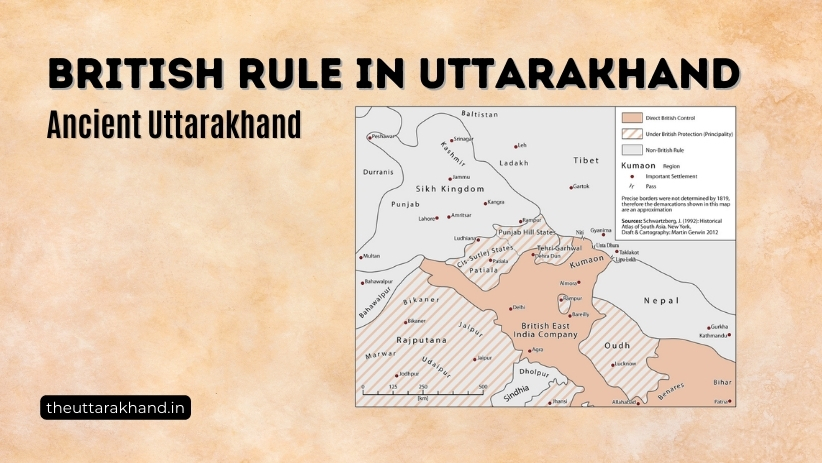
The early 19th century witnessed the rise of the Gurkha empire under the ambitious Gurkha chieftain Prithvi Narayan Shah, who conquered many hill kingdoms including parts of Kumaon and Garhwal. This expansion of the Gurkhas brought them in confrontation with the British East India Company. After the Anglo-Nepalese War (1814-1816), Nepal lost western Tarai and the hill districts which the British then organized into Kumaon and Garhwal provinces under the administration of Delhi.
Political Impact
End of Hill Rajas’ Rule
- The British victory over the Gurkhas ended the independent rule of the hill rajas of Garhwal and Kumaon regions.
- Many small hill chiefs who earlier acted as vassals of the Katyuri kings of Kumaon, Chand rajas of Kumaon or Panwar rajas of Garhwal, now accepted British suzerainty.
- After the war, Garhwal and Kumaon came under the direct control of the British. The hill chiefs were allowed to rule their ancestral territories in lieu of an annual payment made to the East India Company.
Beginning of British Administration
- British established Commissioner’s office, first at Almora (1815) and later at Pauri (1871) to control the Kumaon and Garhwal region.
- The chief administrative officers were the Commissioners who were under the direct control of the Governor General.
- The British organized the hill districts into British Garhwal and British Kumaon provinces.
- The British retained the existing revenue arrangements made by the Gurkhas in Kumaon region. In Garhwal region, they imposed the Regulatoin of 1839.
- After 1857, the administration of NWP (including Kumaon and Garhwal) came under the Lt Governor of the North Western Province based in Agra.
Impact on Politics of Hill Society
- The advent of British rule marked the end of hill Rajas’ authority as independent rulers. Now power rested with the British administrators and army officers.
- Zamindars and village heads who earlier acted as representatives of hill chiefs, now dealt with British officials or army personnel directly for dispute settlements or revenue matters.
- British reduced the status of the hill chiefs to pensioners or jageerdars. However, many hill chiefs actively supported the British during the 1857 Revolt.
Socio-Cultural Impact
Social Reforms
- British administration took active measures to improve the condition of the lower strata of hill society. These communities had suffered social discrimination and economic exploitation under the previous rulers.
- Legal prohibition of slavery and human sacrifice was imposed.
- They promoted modern education by establishing schools and providing scholarships to needy students.
Loss of Patronage to Native Culture
- The new rulers deliberately discouraged traditional customs and cultural practices in the hills to spread Western culture and Christianity.
- With the end of Rajas’ rule, patronage to native language, arts and crafts also declined. Courts, schools and offices now used English and Hindi instead of local languages.
Growth of Modern Education
- British established schools teaching English education and provided scholarships to promote modern Western education.
- In 1821, Captain Young opened the first school in Lohaghat, Kumaon.
- By 1823, the Church Missionary Society had established ten schools in Kumaon.
- The first high school was opened at Almora (1846). Gradually schools were opened in other major towns.
Economic Impact
Changes in Land Revenue System
- The British retained the existing land revenue arrangements in Kumaon region.
- In Garhwal, they imposed the Regulation of 1839 which fixed the state demand at 2/3rd of the supposed rental assets or the amount actually realized by the Sudder Ameen.
- The Regulation granted propriety rights over land to the occupants provided they paid the state revenue in time.
Increase in Land Tax
- The British imposed heavy taxation on the hill people. The tax rate was higher compared to the erstwhile hill kingdoms.
- The land tax amounted to nearly 50-55% of the actual produce. This revenue settlement resulted in widespread poverty and famines in the hills.
Increase in Cultivated Land
- The British encouraged the reclamation and cultivation of wastelands by providing hereditary rights to the settlers.
- Fertile valleys and low hills were brought under plough due to the influx of plainsmen as cultivators.
- Commercial crops like tea, potato, ginger and turmeric were introduced in the hills.
Development of Infrastructure
- Roads connecting the hill towns with the plains were constructed. The roads helped transport cash crops and raw materials from hills to the market towns in plains.
- For ease of administration, the British established their offices at towns which were located at vantage points.
Conclusion to British Rule in Uttarakhand
British Rule in Uttarakhand : The advent of British rule in early 19th century marked a watershed in the history of Uttarakhand. It ended the medieval era hill kingdoms and independent rule of Garhwal and Kumaon rajas. Though the British rule put an end to political instability and warfare in the hills, their economic policies resulted in increased land revenue demands and taxes. This led to famines and distress among the hill peasantry. However, abolition of evil customs like human sacrifice and slavery provided social relief to the oppressed classes. The British also introduced modern education and infrastructure development in this region.
So the impact of colonial rule was a mix of constructive and disruptive forces. It overturned the traditional political, social and economic structure of the hills and brought modern ideas and technology.
FAQ’s on British Rule in Uttarakhand :
When did the British rule start in Uttarakhand?
The British rule in Uttarakhand started in 1815 after the Anglo-Nepalese war and continued till India’s independence in 1947.
How did the British organize Uttarakhand region?
The British organized the Kumaon and Garhwal hill districts into British Garhwal and British Kumaon provinces under a Commissioner.
What was the impact of British land revenue policy?
The British imposed high land taxation leading to increased poverty and famines in the hills.
What were the positive effects of British rule?
The British rule abolished evil customs like slavery and human sacrifice. They also promoted modern education in this region.
Who were the main administrators under the British?
The Commissioners, Deputy Commissioners and district magistrates were the main British administrators in Uttarakhand.