Champawat Culture and Lifestyle

Champawat Culture and Lifestyle
Champawat Culture and Lifestyle
Champawat Culture and Lifestyle : Champawat district, located in the state of Uttarakhand in northern India, is known as the place of origin of culture and religion in the Kumaon region. The land has a rich cultural heritage and is home to ancient temples, monuments, manuscripts, artifacts and folklores that provide evidence of its historical importance.
In this article, we will explore the culture and lifestyle of the people of Champawat, including:
Religious Practices and Ceremonial Traditions
- Temple styles and architecture
- Local deities and modes of worship
- Religious festivals and rituals
Architectural Styles of Houses and Temples
- Traditional house construction
- Temple architecture and key features
Dress and Ornament Traditions
- Traditional attire for men and women
- Jewelry and decorative items
Local Deities and Cultural Traditions
- Prominent deities and legends
- Folk dances, music and theatrical performances
Unique Kumauni Traditions
- Distinct practices related to lifestyle and culture
So let’s begin our journey to understand the vibrant culture of Champawat!
Religious Practices and Ceremonial Traditions
The people of Champawat have deep-rooted religious beliefs that are reflected in their temples, modes of worship and the rituals they practice.
Temple Architecture and Styles
The temples of Champawat showcase a variety of architecture styles, from ornate carvings to simplistic structures. Some key aspects include:
Materials Used – Stone, wood and bricks are commonly used. The ancient temples built by the Chand rulers use stone extensively.
Stylistic Influences – The Kumaoni style has influences of the north Indian Nagara style and the south Indian Dravidian style.
Layout – Temples are oriented towards specific directions based on religious beliefs. The main shrine faces east in most cases.
Decorative Features – Intricate carvings, pillars with ornamental capitals, and paintings depicting deities or floral/geometric patterns.
Some fine examples of sculptural art and architecture are the Baleshwar Temple, Nagnath Temple, Bagnath Temple, Chandika Temple and Purnagiri Temple.
Local Deities and Modes of Worship
Some prominent deities worshipped in Champawat are:
- Lord Shiva – Worshipped in various forms like Bageshwar, Vyagreshwar, Vaidyanath, Nagnath etc.
- Goddess Durga – Revered as the goddess Chandika. Her temples are present in many villages.
- Lord Ganesha – Worshipped as the remover of obstacles before any auspicious work is started.
- Lord Vishnu – Worshipped as the preserver and protector of the universe. Purnagiri temple is dedicated to Vishnu’s boar incarnation.
- Surya – The Sun god. Worshipped for health, prosperity and wisdom.
- Local deities – Golu Devta, Gangnath, Bholenath, Sam, Airi etc. Each village has its own folk deity.
The modes of prayer and worship involve:
- Lighting oil lamps
- Offering flowers, sweets, milk, water
- Chanting mantras and singing bhajans
- Performing aarti
- Applying tilak
Religious Festivals and Rituals
Some important festivals and rituals celebrated in Champawat with great zeal are:
Shivratri – Dedicated to Lord Shiva, it involves devotees fasting and bathing the Shiva lingam with milk and honey.
Navratri – The nine nights festival sees elaborate worship of Goddess Durga. People observe fasts, recite legends and exchange gifts.
Makar Sankranti – Marking the transition of the sun into Capricorn, people take baths in holy rivers, fly kites and make traditional sweets.
Harela – The onset of monsoons is welcomed by planting trees. Prayers are offered to gods for good rainfall.
Khatarua – During Navratri, young girls are ceremonially married to the bel fruit, representing Lord Shiva. This is believed to prevent widowhood.
Bagwal – An ancient tradition performed on Rakshabandhan when villagers offer prayers to Lord Shiva and sacrifice goats.
Jagars – All night gatherings where people sing devotional folk songs and invoke spirits of local deities through masked dancers acting as oracles.
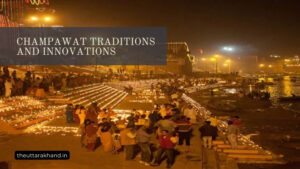
These festivals reaffirm faith in the gods and strengthen community ties. The unique rituals and ceremonies of Champawat form an integral part of its cultural identity.
Architectural Styles of Houses and Temples
The architecture of Champawat displays great ingenuity in construction techniques and artistic embellishment.
Traditional House Construction
Houses in rural areas of Champawat typically use stone, wood and bricks as building materials. Some notable features are:
Two Storeys – Houses have two levels. The ground floor is meant for cattle while the first floor is living quarters for families.
Sloping Roofs – Roofs have slopes to deal with heavy snowfall. Roofing is done using strong timber beams and slates or tin sheets.
Wooden Balconies – Intricately carved balconies and window frames made of deodar wood adorn old houses.
Wall Paintings – Auspicious symbols like the Swastika and geometric/floral motifs are drawn on exterior walls using natural dyes.
Open Courtyards – Larger homes have open inner courtyards with small temples or Tulsi planting areas.
The unique two-storey houses showcase both functional design to deal with weather conditions as well as aesthetic embellishment.
Temple Architecture and Key Features
Temples in Champawat demonstrate specialized design to meet religious requirements. Some structural and decorative elements are:
Pyramidal Towers – Temples have towering pyramidal roofs made of stone. The number of tiers denotes the status of the temple.
Pillared Porches – Entrances have large pillared porches or Mandapas supported by ornately carved brackets.
Torans – Elaborate torans or arched gateways decorated with religious symbols mark the temple entrance.
Plinths – Temples are built on high rising plinths made of stone. Steps provide access to the main shrine.
Engravings – Walls have engraved images of deities, their incarnations, scenes from religious texts as well as floral and geometric patterns.
Fine examples of sculptural skill are seen in the stone temples erected by the Chand rulers in Champawat which have weathered yet stand strong over centuries. Their towering shikharas rising towards the sky are striking landmarks.
Dress and Ornament Traditions
The people of Champawat have preserved their unique identity through their traditional attire and adornments.
Traditional Attire for Women
Women wear vibrant, colourful wraparound skirts called Ghaghri/Pichhora made using handwoven cotton or silk with tie-dye bandhani patterns. They pair it with a short blouse or choli.
Anchol – A special 3 metre cloth dyed yellow with red bandhani motifs and the holy sign of Swastika in the centre. Worn during rituals.
Chadar/Dupatta – Bright chadars or dupattas with bandhani work are draped on the head or shoulders.
Jewelry – Heavy silver jewellery like the Borla (maang tikka), Nath (nose ring), Jhumkis (danglers), Hansuli (necklace) etc. Gold jewellery is also common.
Traditional Attire for Men
Men wear Kurta-Pyjamas made of cotton, linen or wool along with:
Bakhu – A loose woolen overcoat with vibrant embroidery.
Patuka – A cloth headgear with intricate threadwork.
Pattu Pagdi – Brightly coloured turbans worn on special occassions.
Topi – Caps made of wool.
Jewelry – Silver rings called Anguthi.
The traditional outfits provide protection against the cold climate while also reflecting the skilled craftsmanship of the region through their colorful embroidery and mirror-work.
Local Deities and Cultural Traditions
Champawat has a thriving folk culture based around the legends of its local deities and unique art forms.
Prominent Deities and Legends
Some popular folk deities along with their legends are:
Golu Devta – Depicted with a round face and riding a horse. Known for delivering swift justice.
Nagnath – Lord Shiva worshipped as the eternal truth by the sage Gargya.
Buram Dev – The deity of justice whose idol was found buried underground by a cultivator.
Airi – The patron goddess of the Dimri clan. Believed to ride a tiger.
Gangnath – Lord Shiva worshipped by the Pandavas during their exile.
Bholenath – Another form of Lord Shiva regarded as easy to please and benign.
Locals have great reverence for these deities who are seen as guardians of Kumaoni culture. Temples dedicated to them draw devotees from far and wide.
Folk Dances and Music
Champawat has a thriving performing arts scene centered around festivals and religious events. Some examples are:
Chanchari – Women execute graceful movements holding multi-layered lamps.
Jhora – Men holding ornamental sticks dance to fast-paced music.
Hurka Baul – Young men and women dance together using hand gestures to express romance.
Jagars – Dances invoking spirits through energetic drum beats and masked performers.
Music – Devotional folk songs, flutes, shehnais and dhol-damau drums accompany dancers during cultural events.
These lively dances represent the creative spirit of the Kumaonis and their zest for life.
Unique Kumauni Traditions
From food habits to social customs, Champawat has retained certain unique cultural traits despite modern influences.
Cuisine – Staples like Mandua ki roti (millet flatbread), Aloo ke gutke (potato curry), Kafuli (spinach curry), Bhatt ki churkani (black soybean curry) etc. made with locally grown ingredients.
Pithiya – A tilak made of sandalwood paste and rice offered as an auspicious greeting during rituals. Newlyweds apply it too.
Deurali – Miniature stone shrines seen under trees, near springs or at mountain passes where travelers offer prayers.
Kumaoni Holi – Played a day after the rest of North India. People light bonfires to drive out evil spirits.
Johaar – Community volunteer labor during peak agriculture seasons to help farmers.
Patuki – Intricately embroidered headgear worn by men during social gatherings.
Mandapas – Beautiful pavilions built in front of temples for pilgrims to rest.
These traditions strengthen social bonds through collective participation and help preserve the unique cultural essence of the land.
Conclusion to Champawat Culture and Lifestyle
Champawat Culture and Lifestyle : Champawat offers a gateway to experiencing the vibrant culture, artistic heritage and spiritual legacy of the Kumaon region. The ancient temples resonate with tales of the past while festivals burst with joy and camaraderie. Folk arts keep religious stories and moral lessons alive. Traditional dresses and jewelry connect people to the land and its old-world charm. The people have proudly safeguarded their unique identity – whether it is their distinct cuisine, community customs or architectural marvels dotting the countryside. From the snow-capped Himalayas to the dense Sal forests, Champawat’s natural splendor, together with its rich cultural wealth, presents an unforgettable portrait of India’s heritage.