Flora and Fauna of Pithoragarh
Flora and Fauna of Pithoragarh
Flora and Fauna of Pithoragarh
Flora and Fauna of Pithoragarh : Pithoragarh district, located in the Kumaon division of Uttarakhand state, is blessed with immense natural beauty and biodiversity. Situated along the eastern and southern part of the central Himalayas, the district encompasses a great range of elevations, resulting in remarkable diversity in its flora and fauna.
From lush green valleys to snow-capped mountain peaks, Pithoragarh abounds in a variety of vegetation types and wildlife habitats. The forests and alpine meadows here are home to numerous plant and animal species, many of which are of high ecological and economic value.
In this article, we explore the rich biodiversity of Pithoragarh district across various altitudinal zones and vegetation types.
Geography and Climate
Pithoragarh district extends from 29.4° to 30.3° North latitude and 80° to 81° East longitude. It covers an area of around 7218 sq km along the Indo-Tibetan watershed divide in the north and the Kali river forming the border with Nepal in the east.
The district encompasses elevations ranging from about 800 meters in the valleys to over 7000 meters in the higher Himalayan peaks. This great altitudinal range combined with the climatic variations of temperature and precipitation leads to diverse vegetation types in Pithoragarh.
Flora and Fauna of Pithoragarh : Major Vegetation Types
The vegetation of Pithoragarh district can be broadly classified into:
- Tropical forests – Found in the lower valleys up to 1000 m elevation
- Subtropical forests – Between 1000-2000 m elevation
- Temperate forests – 2000-3000 m elevation
- Subalpine forests – 3000-4000 m elevation
- Alpine meadows – Above 4000 m elevation
In addition, there are wetlands, grasslands and scrublands interspersed between these major forest types. Let’s look at some of the characteristic vegetation and important plant species found in each zone.
Tropical Forests
The tropical forests occur in the lower valleys of Pithoragarh up to an elevation of about 1000 meters. These forests have a preponderance of broadleaf tree species such as:
- Sal (Shorea robusta)
- Haldu (Haldina cordifolia)
- Rohini (Mallotus philippensis)
- Jamun (Syzygium cumini)
- Semal (Bombax ceiba)
The understory consists of various shrubs, climbers, herbs and grasses. Some major shrub species found here include:
- Gandhel (Lantana camara)
- Ban kakri (Podophyllum hexandrum)
- Ritha (Sapindus mukorossi)
Many orchids and ferns also thrive in these shady and humid forests along with diverse medicinal plants.
Subtropical Forests
Between 1000-2000 m elevation, the vegetation shifts to subtropical forests dominated mainly by Quercus leucotrichophora (Banj oak) along with these other tree species:
- Burans (Rhododendron arboreum)
- Kaphal (Myrica esculenta)
- Kharsu oak (Quercus glauca)
- Moru oak (Quercus floribunda)
The understory has fragrant shrubs like Murraya koenigii along with Woodfordia, Hypericum, Indigofera, Rubus and wild roses. Temperate herbs like Viola, Fragaria, Potentilla start appearing in the herbaceous layer.
These oak-dominated forests have a lush green canopy in the monsoon season but turn reddish-brown in winters.
Temperate Forests
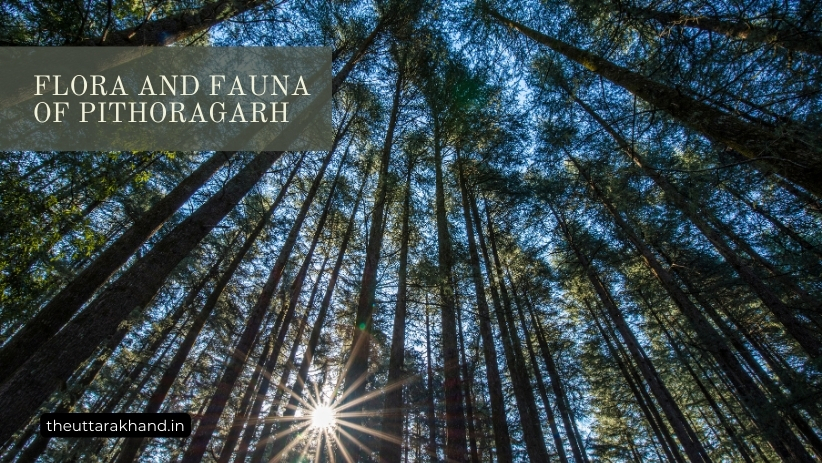
Further uphill between 2000-3000 m elevation, the subtropical vegetation gives way to temperate forests. Here, tall coniferous trees like Pinus roxburghii (Chir pine), Cedrus deodara (Deodar) and Abies pindrow (Raga) form pure stands on northern slopes.
Some broadleaf trees found scattered in this zone include:
- Aesculus indica (Pangar)
- Juglans regia (Akhrot)
- Prunus cornuta (Himalayan cherry)
Shrubs like Indigofera heterantha, Berberis asiatica, Viburnum mullaha grow under the sparse canopy along with Iris kemaonensis, Polygonatum cirrhifolium, Fragaria nubicola and temperate herbs.
Subalpine Forests
Between 3000-4000 m elevation lies the subalpine zone characterized by low-growing rhododendron scrubs, especially Rhododendron campanulatum along with these trees:
- Betula utilis (Bhojpatra)
- Salix denticulata (Himalayan willow)
- Sorbus microphylla (Birmi)
The ground flora includes many colorful wildflowers like Potentilla, Saxifraga, Pedicularis, Primula as well as medicinal herbs belonging to Aconitum, Angelica, Heracleum, Polygonatum, Astilbe, Bergenia.
Alpine Meadows
Above 4000 m lies the alpine zone where no full-sized trees can grow due to the harsh climate. This treeless landscape has rolling grasslands known as bugyals interspersed with low-growing alpine shrubs. Some common species found are:
- Rhododendron anthopogon
- Juniperus sp.
- Dwarf willows
- Cotoneaster microphyllus
The bugyals burst into full bloom in summer displaying a myriad wildflowers such as Potentilla, Gentiana, Delphinium, Saxifraga, Pedicularis, Primula, Meconopsis, Saussurea. These high altitude meadows are also the habitat of many important medicinal herbs.
Major Faunal Groups
Flora and Fauna of Pithoragarh : The forests and alpine meadows of Pithoragarh district are home to diverse animal life belonging to these major faunal groups:
Mammals: Snow leopard, Himalayan tahr, musk deer, Himalayan black bear, barking deer, goral, serow, langur, wild boar, jackal, fox etc.
Birds: Monal pheasant, koklass pheasant, kalij pheasant, cheer pheasant, chir pheasant, snow partridge, bearded vulture, Himalayan griffon, lammergeier, golden eagle etc.
Reptiles: Cobras, vipers, rat snakes, lizards etc.
Butterflies: Apollo, common yellow swallowtail, Paris peacock, red admiral etc.
Now let’s take a closer look at some of the iconic wildlife species found across various habitats in Pithoragarh district.
Flora and Fauna of Pithoragarh : Wildlife Species Found in Pithoragarh
Mammals
Snow Leopard
The snow leopard, also called the ounce, is a large wild cat admirably adapted to the cold, arid mountains above the tree line in the trans-Himalayan region. Its white to smoky grey coat spotted with black rosettes provides perfect camouflage amongst the rocks and snow.
In Pithoragarh, snow leopards are found in the higher reaches of the district in areas like Darma and Byans valleys. These elusive big cats prey chiefly on Himalayan blue sheep and musk deer. They are classified as Vulnerable on the IUCN Red List due to threats like habitat loss, reduced prey populations and retaliatory killing by herders.
Himalayan Tahr
The Himalayan tahr is a stocky wild goat well adapted to living in precipitous mountain terrain. It has a shaggy brown coat with a dark stripe along the back and males have large, curved horns.
Good numbers of tahr are found in the rocky high altitude habitats of Pithoragarh district. They feed on grass and herbs, often digging under the snow for food in winter. Loss of habitat and hunting pressures have led to a 30% decline in their population over the past 30 years.
Musk Deer
Musk deer are primitive deer species named after the strong-smelling reddish-brown secretion musk produced by adult males. They have long upper canine teeth protruding from the mouth of males. Their habitat is high altitude forests and alpine scrubs.
The endangered Himalayan musk deer is found in parts of Pithoragarh district like Byans valley. Highly valued musk pods have led to heavy hunting of the species over decades. Other threats include habitat degradation and predation by snow leopards.
Himalayan Black Bear
The Himalayan black bear is a medium-sized bear with black fur and a distinctive white V-shaped chest mark. It is omnivorous but feeds primarily on fruits, acorns and nuts.
In Pithoragarh, black bears mainly occur in temperate and subalpine oak and rhododendron forests rich in nut-bearing trees. Deforestation leading to food shortages coupled with hunting for body parts used in traditional medicine are major conservation issues.
Barking Deer
The barking deer, also called kakar is a rugged deer species adapted to live under the dense forest canopy as well as open rocky slopes up to 4000 m elevation. When alarmed, they produce a loud, bark-like call, thus the name.
Good populations of barking deer occur in the temperate and subalpine forests of Pithoragarh where they feed on grass, herbs, shrub leaves and fallen fruits. Habitat loss poses survival challenges to them.
Serow
The Himalayan serow is a medium-sized goat-antelope found on steep, rugged mountains and cliffs with scrub forests. They have dark shaggy coats and small backward-curving horns.
Serows are shy, solitary creatures mainly active in early mornings and evenings. They are classified as Vulnerable due to habitat degradation, competition with livestock and hunting pressures.
Goral
The Himalayan goral is a small, rugged wild goat excellently camouflaged to live among rocky cliffs. It has a grey to dark brown shaggy coat with bushy hair below the throat. Males have short, conical horns.
Gorals inhabit wooded hills and precipitous slopes between 1000-4000 m elevation where they feed on grass, herbs and shrub leaves. Habitat disturbance is a major threat to this Near Threatened species.
Wild Boar
The wild boar is a bulky, short-legged and thickset omnivorous mammal recognizable by the prominent ridges of hair along its spine.
Wild boars are adaptable habitat generalists found in the forests and scrublands of Pithoragarh up to about 3000 meters elevation. Their populations have increased significantly in recent years due to expansion of agriculture creating ample food sources like crops and tubers.
Red Fox
The red fox has rusty reddish-brown fur, a bushy tail tipped in white and a pale underbelly. It inhabits various habitats including forests, scrublands, grasslands and alpine meadows up to 5300 m elevation.
Omnivorous red foxes feed on small mammals, birds, reptiles, fruits, insects and carrion. Although still fairly widespread, habitat degradation poses a threat to red fox populations.
Birds
The forests and high peaks of Pithoragarh district are home to nearly 500 species of birds. From multi-colored pheasants and tragopans to majestic eagles and vultures, the avian diversity here is remarkable. Let’s learn about some special birds found in the region.
Monal Pheasant
The monal pheasant is the state bird of Uttarakhand instantly recognizable by the male’s iridescent multi-hued plumage and distinctive crest. The females are mottled brown in color.
This magnificent pheasant inhabits temperate and subalpine forests between 2000-4500 m elevation. Monal populations have declined significantly due to habitat degradation and hunting pressures. They are listed as Least Concern currently on the IUCN Red List.
Koklass Pheasant
The koklass pheasant is another pheasant species found in the temperate pine and oak forests of Pithoragarh district. The male has a grey plumage with reddish-brown throat feathers and distinctive crimson eye-rings.
Koklass feed on seeds, leaves, buds, insects and berries. While still widespread, their numbers are decreasing gradually due to hunting and deforestation.
Kalij Pheasant
The Kalij pheasant is a medium-sized dark-grey pheasant with a greenish gloss on the body, reddish face and legs. The male has a black bib and long tail feathers. Kalij inhabit scrublands and dense broadleaf forests up to 2700 m elevation where they feed on seeds, leaves, berries and insects.
Even though kalij pheasants are Least Concern presently owing to their wide distribution, habitat pressures coupled with hunting for meat are reducing their populations.
Cheer Pheasant
The cheer pheasant is aptly named after its whistling territorial call. The male has a distinctive white crest and narrow black band from the eyes to the crest. Females are mottled brown with white facial markings.
Cheers occur in temperate and subalpine forests between 1500-3000 m elevation. They forage on the forest floor for seeds, leaves, berries and insects. Habitat loss and hunting are major threats causing cheer pheasant populations to decline.
Lammergeier
The lammergeier, also called bearded vulture, is a large Old World vulture with weak talons but very powerful bill adapted to feed on bones and marrow of dead animals. They have specialized digestive acids to dissolve even large bones.
Lammergeiers frequent high mountains and remote valleys hunting wild prey. In Pithoragarh, they occur mainly in areas like the Panchachuli base. Poisoning, disturbance of nesting sites and reduced food availability endanger these majestic bone-eaters.
Himalayan Griffon
The Himalayan griffon is an enormous vulture with brownish plumage and pale neck ruff. It breeds on cliffs and hunts carrion on the ground often in large flocks.
Good numbers of Himalayan griffon can be seen riding thermals above the Kumaon hills. Like all vulture species, griffon populations have suffered huge declines recently due to poisoning, shortage of wild prey and disturbance at breeding colonies.
Golden Eagle
The golden eagle is one of the largest and most powerful birds of prey in the world. It has broad wings and a golden brown plumage with a golden nape distinctive of adults.
Golden eagles inhabit hilly and mountainous regions locating their huge nests on cliffs. In Pithoragarh, they occur across various habitats from grasslands to rocky peaks up to 5200 m elevation. Though still fairly widely distributed, habitat pressures and disturbance are conservation issues.
Conclusion to Flora and Fauna of Pithoragarh
Flora and Fauna of Pithoragarh, Pithoragarh district harbors tremendous biodiversity across its elevational gradient from tropical valley forests to alpine meadows. The area is home to many endemic wildlife species as well as threatened flora and fauna of high conservation value.
However, habitat loss and overexploitation threaten the long-term survival of several plants and animals here. Concerted conservation efforts involving local communities are vital to preserve Pithoragarh’s natural heritage for posterity through sustainable use and ecosystem restoration initiatives. The rich biodiversity underpins the ecology, economy and culture of the region. Thus it is imperative to conserve it by addressing the environmental challenges facing the district.