Lord Vishnu’s Footprint at Har-Ki-Pauri in Haridwar
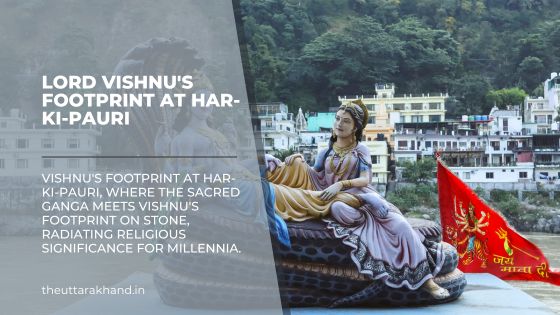
Vishnu's Footprint at Har-Ki-Pauri
Vishnu’s Footprint at Har-Ki-Pauri
Vishnu’s Footprint at Har-Ki-Pauri : The holy city of Haridwar, meaning ‘Gateway to Gods’, is one of the seven sacred cities in India and an ancient pilgrimage destination for Hindus. Located in the Haridwar district of Uttarakhand, this spiritual town has attracted devotees for thousands of years to bathe in the sacred Ganga river.
Haridwar holds great religious significance and cultural heritage. It has been sanctified by the presence of the Trinity of Gods – Brahma, Vishnu and Mahesh. The district resonates with spirituality through its numerous temples, ashrams, ancient scriptures and the legendary Kumbh Mela.
The Holy Ganga
The identity of Haridwar is defined by the River Ganga. As per Hindu mythology, King Bhagirath brought the river Ganga from heaven to earth to provide salvation to his ancestors. It is believed taking a dip in the Ganga absolves devotees of their sins and helps them attain salvation.
Several bathing ghats line the banks of the Ganga in Haridwar, the most significant being Har-Ki-Pauri.
Har-Ki-Pauri
Vishnu’s Footprint at Har-Ki-Pauri : Har-Ki-Pauri translates to the Footstep of God. It refers to the imprint of Lord Vishnu’s footprint on a stone wall. As per Hindu scriptures, during the Samudra Manthan when the gods and demons churned the ocean for Amrit, Lord Vishnu flew away with the Kumbh of Amrit. It is believed that during this chase, he stepped on a stone and left his footprint behind.
The stone with the footprint is built into the wall enclosing the Har-Ki-Pauri ghat. It signifies the presence of the Trinity Gods in Haridwar. The wall also has imprints of the footprints of Goddess Ganga.
Religious Significance
As per Hindu beliefs, Har-Ki-Pauri is considered one of the holiest spots in Haridwar.
- The sacred Ganga touches the footprint all the time. Devout Hindus feel taking a dip here with utmost faith grants salvation.
- It is believed that drops of Amrit fell into the Brahmakund at this ghat. Hence, it is considered highly auspicious for ritual bathing.
- During auspicious occasions like Somwati Amavasya, solar eclipses, the Kumbh festival etc lakhs gather here for a holy dip.
The evening Ganga Aarti performed at sunset at the ghat is a sight to behold with the waterfront lit with floating diyas.
Scriptural Significance
Haridwar finds mention in several ancient Hindu scriptures. The Vishnu Purana (1st-3rd century CE) refers to it as Kapilsthan, the hermitage home of the sage, Kapila. Other Puranas like the Bhagavata Purana (10th century CE) and the Mahabharata (400 BCE – 400 CE) extol its sanctity.
As per legends, Haridwar has been home to Devrishi Narad and is visited by the Panch Pandavas. The Pandava prince Bhima is said to have installed the Bhima Shila, a large rock, at Har-ki-Paudi. The Bhagavad Gita and several Upanishads contain references to Haridwar and the Ganga.
Kumbh Mela
The Kumbh Mela held in Haridwar once every 12 years is the largest religious pilgrimage on earth. It is believed during the holy occasion of Kumbh, drops of Amrit fell in Haridwar. Millions gather on the banks of Ganga Brahma Kund in Har-Ki-Pauri to bathe in its spiritually charged waters.
Conclusion about Vishnu’s Footprint at Har-Ki-Pauri
Vishnu’s Footprint at Har-Ki-Pauri : The mention of Lord Vishnu’s footprint on a stone wall at the Har-Ki-Pauri ghat stands testament to the religious eminence of Haridwar. The enduring faith of millions considering Haridwar and Ganga sacred for thousands of years establishes it as one of the holiest places of Hindu pilgrimage.
Key Highlights about Vishnu’s Footprint at Har-Ki-Pauri
- Haridwar’s identity defined by River Ganga and its ghats like Har-Ki-Pauri
- Har-Ki-Pauri: Footstep of God, Vishnu’s footprint imprinted on stone wall
- Highly sacred spot, holy dip believed to provide salvation
- Mentioned in Hindu scriptures extolling its sanctity
- Venue of Kumbh Mela, world’s largest religious pilgrimage
- Enduring and unshakeable faith of millions over thousands of years