Modern Uttarakhand History (1790 AD till Independence)
Modern Uttarakhand history from 1790-1947 witnessed major political changes from Gorkha rule to British administration and finally independence.
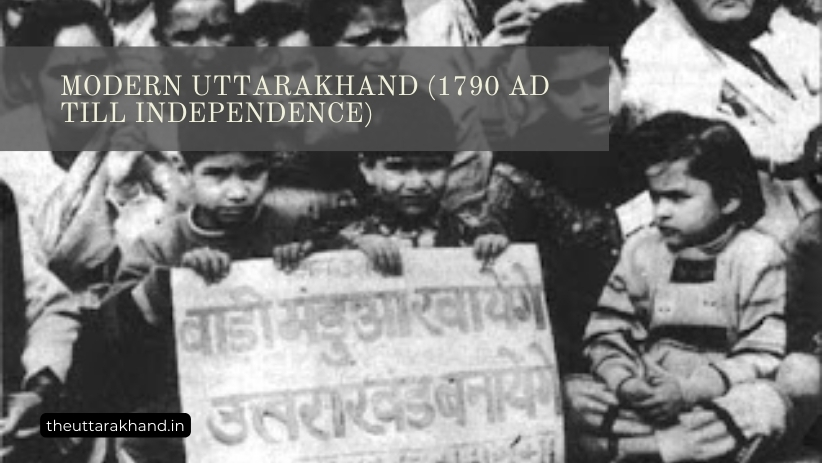
Modern Uttarakhand (1790 AD till Independence)
Modern Uttarakhand (1790 AD till Independence) : The modern history of Uttarakhand spans from 1790 AD till India’s independence in 1947. This period witnessed significant political, social and cultural changes in the region. Uttarakhand was ruled by the Gorkhas and the British during this time. Rebellions against foreign rule and movements for social reform also shaped the modern history of Uttarakhand.
Gorkha Rule and Anglo-Gorkha War
In 1790 AD, the Gorkhas from Nepal invaded Kumaon and Garhwal regions of Uttarakhand under the leadership of Amar Singh Thapa. By 1803, the Gorkhas had captured major parts of Garhwal and Kumaon. Their oppressive rule led to much resentment among the local populace.
In 1814, the East India Company declared war on the Gorkha kingdom leading to the Anglo-Gorkha War (1814-1816). The British emerged victorious in this war with the Treaty of Sugauli signed in 1816. As per this treaty, the Gorkhas had to cede Kumaon and Garhwal regions which came under British control.
Key Events during British Rule
Administrative Changes
The British made several administrative changes in Kumaon and Garhwal regions:
- 1815 – Garhwal region was placed under a Commissioner while Kumaon division was established with a Commissioner in Almora.
- 1837 – Kumaon division was placed under the Lieutenant Governor of the North-Western Provinces based in Agra.
- 1857 – After the Revolt of 1857, a new province called North Western Provinces and Oudh was created. Kumaon division became part of this province with headquarters at Allahabad while Garhwal region remained a separate Commissioner’s division.
- 1891 – Kumaon division was separated from the North Western Provinces and merged with the Garhwal region to form a new province known as the United Provinces of Agra and Oudh.
Socio-Religious Reforms
The British promoted reforms in social and religious spheres in Kumaon and Garhwal region:
- Abolition of cruel practices like Sati (1829) and infanticide.
- Promotion of women’s education through schools.
- Spread of modern education through schools teaching English and Sciences.
- Infrastructure development like motorable roads and rail links.
However, high land revenue demands and forced labor policies led to growing resentment among locals against British rule.
Key Rebellions and Freedom Movement
Uttarakhand witnessed several local revolts and participation in the wider Indian freedom struggle:
Early Rebellions
- Gurkha Rebellion (1816) – Attempt by exiled Gurkha leader Bam Shah to recapture Kumaon region. The British suppressed this rebellion.
- Koli Rebellion (1816) – The Koli community in Kumaon region rebelled against British oppression. This rebellion too failed.
Revolt of 1857
The revolt of 1857, also known as India’s First War of Independence had an echo in Kumaon and Garhwal regions as well. Some key events were:
- Attack on British garrison in Almora but the rebels failed to achieve much success.
- Revolt in Srinagar (Garhwal) led by Govind Pant. He proclaimed himself as king but was later defeated by the British.
- In Lohaghat, a rebel force led by Lal Singh occupied the area for sometime.
The revolt was crushed by the British within a few months. The leaders like Govind Pant were captured and killed.
Early National Movement
People of Uttarakhand participated actively in the early national movement:
- Surendranath Banerjee’s visit (1884) – Inspired locals to support the Indian National Congress founded in 1885.
- Home Rule Leagues (1916) – Several branches opened in Kumaon and Garhwal regions during Lucknow Pact.
- Non-cooperation Movement (1921) – Massive protests across Uttarakhand, bonfires of foreign goods etc.
Forest Satyagraha (1930)
The famous Forest Satyagraha was launched in present-day Uttarakhand in 1930 by the Van Panchayats to demand rights over forest resources. Under the leadership of Gandhian social worker Mira Behn (Madeline Slade), peaceful protests were organized through hunger strikes, marches etc. Finally, the British had to concede some rights through the Forest Act of 1931. The movement marked the entry of women into India’s freedom struggle.
Quit India Movement (1942)
The Quit India Movement sparked protests across Uttarakhand as well. The prominent events were:
- Large scale demonstrations took place in Dehradun, Almora, Nainital and other parts.
- Parallel governments were established for some time in Almora and Pithoragarh districts.
- Government buildings were attacked and post offices/telegraph lines disrupted. The British took brutal steps to suppress the revolt. Hundreds were killed in police firings while thousands were arrested.
By the end of British rule in 1947, most of present-day Uttarakhand had become active participants in India’s national movement through mass protests, rebellion as well as constructive programs.
Prominent Freedom Fighters
Uttarakhand produced many towering personalities who played a stellar role in the Indian freedom struggle:
1. Gaura Devi (1925-1991)
Popularly known as the “Chipko Queen”, she mobilized local women in Reni village of Garhwal district to save trees by hugging them, thus giving birth to the world-famous Chipko Movement in 1973.
2. Sunderlal Bahuguna (1927-2021)
A Gandhian activist, he led the Chipko Movement along with Mira Behn and Chandi Prasad Bhatt. He highlighted the importance of preserving Himalayan ecology. Government awarded Padma Vibhushan to him.
3. Chandi Prasad Bhatt
A Gandhian socialist, he started the Dasholi Gram Swarajya Sangh in Gopeshwar. Along with Bahuguna, he pioneered the Chipko Movement. He was awarded the Padma Bhushan in 2005.
4. Govind Ballabh Pant (1887–1961)
A leading lawyer and influential political figure, he served as Premier of United Provinces from 1937 to 1939. After independence, he was elected CM of UP and served as Union Home Minister and Minister for States.
5. Indramani Badoni (1905-2000)
He led the Forest Satyagraha of 1930 along with Mira Behn. Later he served as revenue minister of UP.
Through their selfless sacrifices and courage, these great souls played a pivotal role in shaping the destiny of Uttarakhand and India.
Conclusion to Modern Uttarakhand (1790 AD till Independence)
Modern Uttarakhand (1790 AD till Independence) : The modern history of Uttarakhand from 1790 AD till independence is thus a saga of people’s struggle against oppressive foreign rule as well as a quest for social and religious reforms. From the Gorkha invasion of 1790 to the launch of defining movements like Chipko, the region actively participated in various events, rebellions and protests that characterized India’s journey towards freedom. The sacrifices of regional leaders like Gaura Devi, Sunderlal Bahuguna, Chandi Prasad Bhatt and others finally bore fruit when India achieved independence in 1947.
Modern Uttarakhand (1790 AD till Independence) :
Q: When did the Gorkhas invade Garhwal and Kumaon regions?
A: The Gorkhas invaded Garhwal in 1804 and Kumaon in 1790 under Amar Singh Thapa.
Q: What led to the Anglo-Gorkha war between British and Gorkhas?
A: The oppressive Gorkha rule caused much resentment among locals which prompted the British East India Company to declare war on the Gorkhas in 1814.
Q: When did Uttarakhand come under British rule?
A: After defeating Gorkhas, the British took over administration of Garhwal and Kumaon regions in 1816 as per the Treaty of Sugauli.
Q: How did Uttarakhand participate in India’s freedom movement?
A: People of Uttarakhand actively participated in various events like non-cooperation movement, quit India movement through protests, strikes and establishment of parallel governments.
Q: When did Uttarakhand become part of independent India?
A: At independence in 1947, most parts of present-day Uttarakhand were under United Provinces and thus became part of independent India.