Inspiring Historical Figures from Uttarakhand
Historical Figures from Uttarakhand
Introduction to Inspiring Historical Figures from Uttarakhand
Inspiring Historical Figures from Uttarakhand : Uttarakhand, nestled in the lap of the mighty Himalayas, has a rich history and culture. Throughout the ages, many great personalities have emerged from this region who have made significant contributions in diverse fields.
In this article, we will explore some of the most inspiring historical figures from Uttarakhand across different eras – from the freedom struggle to environment conservation and more. These personalities overcame tough odds and challenged circumstances to rise to eminent positions. Their stories continue to motivate people from Uttarakhand and beyond.
Freedom Fighters
Veer Chandra Singh Garhwali
Introduction: Veer Chandra Singh Garhwali was one of the most iconic freedom fighters from Uttarakhand. His courage and conviction continue to inspire generations.
Early Life: He was born on 17 September 1901 in a Garhwali Rajput family in Tehri Garhwal district. He joined the British Indian Army at age 20 and rose to become a Havildar (Sergeant) by 1927.
Pivotal Moment: In 1930, troops under his command were ordered to open fire on unarmed civilians protesting the Salt Tax at Peshawar (now in Pakistan). He courageously refused to order firing, an act for which he was imprisoned and dismissed from service.
Role in Freedom Struggle: After release, he actively participated in the freedom movement and was imprisoned again during the Quit India Movement. He later joined the Indian National Army under Netaji Subhash Chandra Bose.
Post Independence: After independence, he continued serving people through politics and social work. The Indian Postal Service issued a stamp in his honor in 2001.
Key Takeaways: Veer Chandra Singh’s courageous defiance of British orders made him a national icon of the Indian freedom struggle. His unwavering commitment to non-violence and justice continues to inspire people.
Govind Ballabh Pant
Introduction: A key architect of modern India, Govind Ballabh Pant was one of the tallest national leaders from Uttarakhand during the independence movement.
Early Life and Education: Born on 10 September 1887 in Almora district, he graduated in Law from Allahabad University. He started legal practice at Kashipur town in 1907.
Entry into Politics: He joined the freedom struggle in 1921 and participated in the Non-Cooperation Movement. He was imprisoned for several months.
Rise to National Prominence: Elected to the Central Legislative Assembly in 1926, he rose to become a top Congress leader. He was twice elected as Uttar Pradesh Chief Minister and played a pivotal role in zamindari abolition and industrialization.
Union Home Minister: As India’s Home Minister(1955-61) he helped consolidate national unity and oversaw administration of various states. Several institutions including IIT Kanpur and the Govind Ballabh Pant Social Science Institute were established by him.
Key Takeaways: G.B Pant’s administrative acumen, unblemished integrity and commitment to public welfare cemented his position among the greatest nation builders.
Kashi Singh Airy
Introduction: A key organizer of the famous Salt Satyagraha March in 1930, Kashi Singh Airy was an ardent freedom fighter from Tehri Garhwal.
Early Life and Education Born in 1894 at Pratapnagar, he graduated from the Prince of Wales College (now Govt. Inter College) in Dehradun.
Entry into Politics Inspired by Gandhiji, he joined the freedom movement while studying Law at Allahabad University.
Role in Freedom Struggle He actively spread awareness on Swadeshi, prohibition and Khadi among people. As secretary of the Tehri riyasat Prajamandal, he led the iconic Salt March from Tehri town to Dehradun Jail in May 1930. Over 150 satyagrahis were arrested.
He later participated actively in the Quit India Movement and was imprisoned in 1942-43.
Post Independence Public Service After independence he served as a Minister in the Tehri princely state during 1948-49. He was actively involved in establishing schools, libraries and social institutions in Tehri region.
The K.S Airy Memorial Inter-College in Pratapnagar and a key street in Dehradun commemorate his inspiring legacy.
Inspiring Historical Figures from Uttarakhand : Pioneers of Women’s Empowerment
Gaura Devi
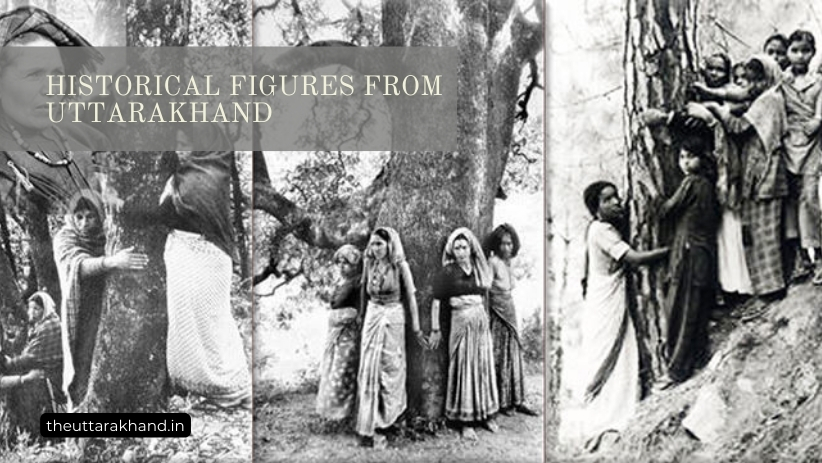
Introduction: A remarkable environmental activist, Gaura Devi led the iconic Chipko Movement marking a historic milestone in women’s activism globally.
Early Life: Born in 1925 in Reni village (Chamoli district), she lost her father at age 5 and helped the family by grazing goats in the hills since childhood.
The Pivotal Incident: In March 1974, revenue officials arrived to auction ash trees near her village. Gaura Devi mobilized local women and confronted the contractors by hugging the trees, thus sparking the Chipko Movement.
National Icon: As the Chipko Movement spread, she emerged as a grassroots leader traveling across the region to spread awareness on forest conservation. She was awarded the Jamnalal Bajaj Award in 1986 and Padma Shri in 2005.
Key Takeaways: By spearheading Chipko Movement and championing women’s activism, she inspired the rise of ecofeminism in India. Her courage continues to motivate women leaders globally.
Anusuya Prasad Maikhuri
Introduction: A champion of women’s rights and rural development, Anusuya Maikhuri played a pioneering role in the upliftment of women in Uttarakhand.
Early Life and Education: She was born in Almora district in 1913. After graduating from Lucknow University, she started teaching in Pithoragarh during the 1930s.
Entry into Social Service: Widowed at a young age in 1945, she dedicated her life to social work. She established Mahila Mangal Dals (Women Welfare Groups) and Bal Vikas Samitis (Children Welfare Associations) across Kumaon region.
Key Contributions: Her grassroot level work in remote hills impacted thousands of women through initiatives like child health care, adult literacy, income generation, anti-dowry campaigns and more. She helped set up over 50 Mahila Mangal Dals in the region.
The Government of India honored her with a Padma Shri award in 1981 recognizing her inspiring legacy.
Environmental Conservation
Sunderlal Bahuguna
Introduction: One of India’s most renowned environmental activists, Sunderlal Bahuguna’s philosophical ideals and grassroot level mobilization were pivotal to the success of Chipko Movement.
Early Life and Education Born in 1927 in Tehri Garhwal district, he graduated with a degree in Chemistry and pursued a career as a teacher before entering social service.
Entry into Environmental Activism In the early 1970s he observed rampant felling of trees by contractors around the Himalayas causing massive landslides and floods. To create awareness, he undertook a 5000-km trans-Himalayan foot march in 1981-83 spanning from Kashmir to Arunachal Pradesh.
Leading the Chipko Movement: Bahuguna infused Gandhian values into the Chipko Movement of the 1970s which spread across Uttarakhand through grassroot level women’s activism. His community mobilization and peaceful resistance against deforestation drew global attention.
Key Takeaways: Sunderlal Bahuguna’s philosophical advocacy and community mobilization played a key role in shaping policies on forest conservation and environmental protection both in India and abroad.
In 2009, he was awarded the prestigious Padma Vibhushan for his contribution to environmental conservation.
Chandi Prasad Bhatt
Introduction: A Gandhian environmentalist, Chandi Prasad Bhatt played a pioneering role in mobilizing grassroot awareness and activism leading up to the Chipko Movement.
Early Life and Education: Born in 1934 in Rudraprayag district, he graduated from Allahabad University and joined as a social worker in 1959.
Mobilizing Villagers Against Deforestation: Witnessing massive destruction of Himalayan forests in 1960s, he began creating environmental awareness through village meetings, foot marches and hunger strikes. His efforts led to the first Chipko Action in 1973 at Mandal village where local women hugged trees to stop contractors.
Driving Force of Chipko Movement: As a grassroot worker, he mobilized activists including village women to save forests through peaceful Satyagraha. In 1981, he led the first ever environmental protest rally from Kashmir to Kohima spread over 8000 km.
Key Takeaways: Bhatt’s philosophical advocacy and community mobilization were pivotal in raising global awareness on deforestation in the Himalayas, thus heralding the eco-feminist Chipko Movement.
In 2013, he was honored with the Gandhi Peace Prize recognizing his fight for social justice and environmental conservation.
Preservers of Culture and Heritage
Shekhar Pathak
Introduction: An acclaimed historian and conservationist, Shekhar Pathak is renowned for his pioneering research on the ecology, society and culture of Himalayas.
Early Life and Education: Born in 1960 in Pithoragarh district, he graduated from Hemwati Nandan Bahuguna Garhwal University and later completed M.Phil in History.
Key Contributions: Through extensive field research and study of archival records, he has authored over 100 books and research papers on the Garhwal Himalayas. His works have unravelled fascinating insights on the historical evolution, cultural heritage and anthropological aspects of the region.
Pioneering Achievements
- Discovered the archaeological remains of King Yudhisthir’s legendary palace at Pandukholi.
- Led exploratory expeditions to Burphu and Kafni glaciers.
- Served as Member Secretary of Nehru Institute of Mountaineering and State Biodiversity Board.
- Awarded Padma Shri for his contribution in the field of Literature and Education.
Takeaway: Through his scholarly research and exploration of the Himalayas, Shekhar Pathak has highlighted the rich cultural legacy and environment heritage of Uttarakhand.
Shekhar Chandra Joshi
Introduction: A leading cultural historian, Shekhar Chandra Joshi is renowned for his seminal research on the evolution of civilizations across the Himalayas and Sub-Himalayan ranges.
Early Life and Education Born in Almora in 1937, he studied ancient history at Lucknow University and later conducted doctoral research at Benares Hindu University.
Key Contributions: Through extensive anthropological field surveys across 5000 villages, he collected archival data on cultural practices, faith systems, folk traditions etc. His path-breaking research works have unravelled fascinating linkages between ancient communities across the Trans-Himalayan belt.
Pioneering Achievements:
- Authored over 100 research papers and books highlighting cultural continuities between ancient communities across the Himalayas.
- Discovered megalithic sites shedding light on old trading and migration patterns connecting Central Asia and Tibet with Indian plains.
- Awarded Padma Shri for his contribution in anthropology and literature.
Takeaway: Through decades of meticulous research, Dr. Joshi has greatly expanded our understanding of the cultural evolution and connectivity of Himalayan communities since ancient times.
Inspiring Historical Figures from Uttarakhand : Leaders Across Diverse Fields
Manohar Shyam Joshi
Introduction: One of the most influential literary figures from Uttarakhand, Manohar Shyam Joshi is renowned for his bestselling novels and stories highlighting the rich cultural traditions of Kumaon.
Writing Style and Themes: Drawing vivid portraits of Kumaoni people and culture, his novels showcase the simple joys and tribulations of common folk. His iconic novel ‘Kashi Ka Assi’ captures the vibrant street life in Varanasi.
Bestselling Works: Some of his best known novels include Kille Ka Rahasya, Ek Tha Gadha Urf Albert Einstein, Appiko and Tirich. Many of his works have been adapted into popular TV series and films.
Literary Accolades: He was awarded the Sahitya Akademi Award in 1982, Padma Shri in 2006 and Padma Bhushan in 2022 recognizing his outstanding contribution to Indian literature.
Key Takeaway: Through his gripping stories, Joshi has beautifully captured the cultural ethos and richness of the land and people of the Kumaon hills.
Bachendri Pal
Introduction: An accomplished mountaineer and adventurer, Bachendri Pal is internationally renowned for her outstanding achievements in the field of mountaineering.
Pioneering Feats
- In 1984 she became the first Indian woman to reach the summit of Mount Everest.
- Led India’s first successful all-women expedition to Antarctica in 1994.
- In 1999, she led the first Indian mixed-gender rafting expedition on the Amazon river.
Awards and Recognition
- Awarded the Padma Shri and Tenzing Norgay National Adventure Award
- Served as Director of the Nehru Institute of Mountaineering
Key Takeaway As an ace mountaineer, adventurer and youth icon, Bachendri Pal has pushed boundaries of human endurance and gender stereotypes.
Ruskin Bond
Introduction: One of India’s most beloved children’s authors, Ruskin Bond is renowned for his simple yet captivating stories set amidst the Himalayan foothills.
Key Themes and Style: Through his semi-autobiographical stories, he poignantly captures the beauty of nature and common joys and challenges of rural life in Uttarakhand where he has long resided.
Renowned Works: Some of his most popular story titles are The Room on the Roof, Rusty the Boy from the Hills, Delhi is Not Far and Tales from the Hills. Several stories have been adapted into popular Bollywood films.
Literary Honours: He received the Sahitya Akademi Award in 1992 and Padma Shri in 1999 recognizing his outstanding contribution to children’s literature.
Key Takeaway: As one of India’s most prolific writers, Ruskin Bond has beautifully captured the essence of life in the Uttarakhand hills through heartwarming stories for readers across generations.
Conclusion to Inspiring Historical Figures from Uttarakhand
Inspiring Historical Figures from Uttarakhand : The state of Uttarakhand has given birth to great leaders across the ages. While some ignited sparks of revolution from the freedom struggle to environmental conservation, others gained eminence through artistic creativity and scholarly research.
The legacy of these inspiring figures continues to motivate younger generations from Uttarakhand to aim for excellence and stay committed to the welfare of people and conservation of their beautiful Himalayan homeland.
Their stories reflect the enterprising spirit and cultural richness innate to the people of Uttarakhand. As the state continues to develop in the 21st century, the enduring legacies of its most iconic historical figures will remain a guiding light towards a progressive future rooted in social justice and environmental wisdom.
FAQs:
Q1. Which key freedom fighter from Uttarakhand refused to open fire on civilians protesting the Salt Tax?
Ans: Veer Chandra Singh Garhwali courageously refused to order firing on civilians protesting the Salt Tax at Peshawar, for which he was imprisoned.
Q2. Who led the iconic Chipko Movement that started in Uttarakhand?
Ans: Chipko Movement was led by renowned environmental activists Sunderlal Bahuguna, Chandi Prasad Bhatt and grassroot women activists like Gaura Devi.
Q3. Name the first Indian woman to climb Mount Everest who hails from Uttarakhand.
Ans: Bachendri Pal from Uttarakhand became the first Indian woman to reach the summit of Mount Everest in 1984.
Q4. Which literary icon from Uttarakhand is renowned for his novels showcasing Kumaoni culture?
Ans: Manohar Shyam Joshi is renowned for bestselling novels like Kashi Ka Assi beautifully capturing the cultural richness of Kumaon hills.
Q5. Who led the Salt March from Tehri town to Dehradun Jail as part of the 1930 Civil Disobedience Movement?
Ans: Kashi Singh Airy, an ardent freedom fighter from Tehri Garhwal, led the iconic Salt March during the 1930 Civil Disobedience Movement.