Kushana Coins in Ancient Uttarakhand
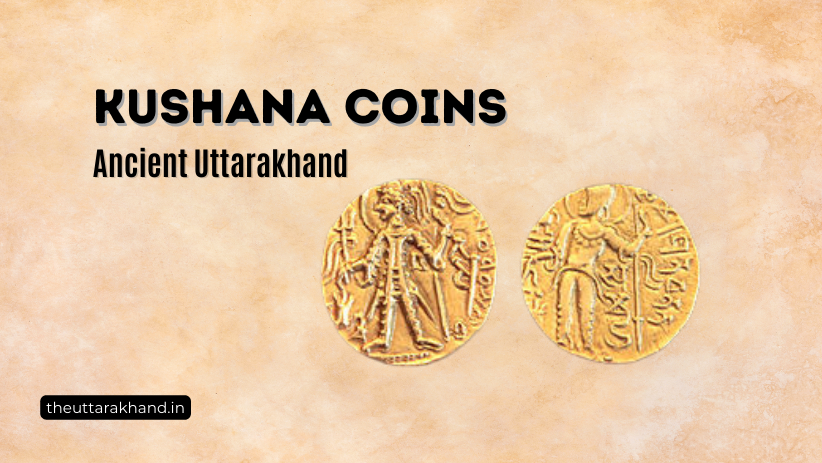
Kushana Coins in Ancient Uttarakhand
Kushana Coins in Ancient Uttarakhand
Kushana Coins in Ancient Uttarakhand : The Kushana dynasty ruled over parts of Central Asia and the northern Indian subcontinent between the 1st and early 4th century CE. They are known for establishing a strong empire that spread Indian culture in Central Asia and promoted trade across Asia and Europe. An important aspect of the Kushana rule was the coins they issued. In this article, we will explore the Kushana coins in detail – their history, significance, imagery, legends, metals, denominations etc.
Chronology of Kushana Rulers
Before delving into Kushana numismatics, let us briefly look at the Kushana rulers and the time period of their rule:
Kujula Kadphises – Circa 30–80 CE
Vima Takto – Circa 80–105 CE
Vima Kadphises – Circa 105–127 CE
Kanishka I – Circa 127–163 CE
Huvishka – Circa 163–213 CE
Vasudeva I – Circa 213–232 CE
Kanishka II – Circa 232–240 CE
Vashishka – Circa 240–250 CE
Kanishka III – Circa 250–275 CE
Vasudeva II – Circa 275–310 CE
Vasudeva III – Circa 310–325 CE
Significance
The Kushana coins provide great insight into the Kushana empire – its chronology, extent, socio-economic conditions, religious beliefs, artistic styles etc. Some key significances are:
- They help establish the chronology and succession of Kushana rulers due to the depiction of kings’ names and titles.
- The extent of the Kushana empire can be determined by the wide geographical spread of coin finds.
- The language and script on coins show the multi-ethnic nature of the Kushana empire.
- The coin imagery and legends give information about the religious beliefs, Central Asian/Indian syncretism and official propaganda under different Kushana rulers.
- Details about administrative systems, economic conditions, trade networks etc. can also be deduced from the coins.
- Stylistically, they showcase an amalgamation of Indian, Greek, Persian and Central Asian artistic influences.
So in many ways, Kushana coins serve as small encapsulations of the cultural and political developments under the Kushanas.
Early Coins of Kujula Kadphises
The first ruler of the Kushana empire, Kujula Kadphises, minted gold and copper coins on the weight standard used by the preceding Indo-Greek and Indo-Parthian kings.
Obverse: Portrait of the king facing right, wearing a loose turban-like head dress. Greek legend surrounding portrait reads: ΚΟΖΟΥΛΟΥ ΚΑΔΦΙΣΟΥ – “Of Kozoulo Kadphises”
Reverse: Depicts Heracles standing facing, crowning himself with a wreath and holding a club. The Greek inscription reads ΗΡΑΚΛΕΟΥΣ ΣΩΤΗΡΟΣ ΚΟΖΟΥΛΟΥ ΚΑΔΦΙΣΟΥ – “The Saviour Heracles, of Kozoulo Kadphises”
The portrait shows Kujula with a rugged, weather-beaten face – reflecting his Central Asian origins and warrior lifestyle. The depiction of Heracles reflects Kujula’s claims to be his incarnation. Heracles was a popular deity in the Greco-Bactrian kingdom that the Kushanas overthrew. So his depiction asserts Kujula’s takeover.
Bilingual Coinage of Vima Takto
Kujula Kadphises’ son Vima Takto introduced gold bilingual coins featuring both Greek and Kharoshthi legends – highlighting the multi-ethnic nature of the Kushana empire.
Obverse: Diademed bust of king facing right, in Kharoshthi script: maharajasa rajadirajasa sarvalogavardhasa Vima Taktu – “The great king of kings Vima Takto, the increaser of all people”
Reverse: Standing figure of Pharro/Shiva holding a trident, with Nandi bull behind. Greek legend reads: ΒΑΣΙΛΕΥΣ ΒΑΣΙΛΕΩΝ ΟΟΗΜΟ ΤΑΚΤΟ – “The king of kings, the great Vima Takto”
The bilingualism indicates that the Kushanas now ruled over both Greek-using and Indian populations. The Shiva imagery shows the incorporation of Hindu iconography and an emerging Kushana-Hindu syncretism.
Gold Coins of Vima Kadphises
Vima Kadphises built upon his father’s bilingual experiment and issued more gold coins with a unique mix of Indian, Greek, Persian and Central Asian elements:
Obverse: Helmeted bust of the king facing right wearing a coat of mail. Legend in corrupted Greek script reads: ΟΟΗΜΟ ΚΑΔΦΙ – “The great Vima Kadphises”
Reverse: Depicts Shiva and his bull Nandi. The right field has Kharoshthi legend maharajasa rajadirajasa sarvalogavardhasa Vima Kadphisesa – “Of the great king of kings Vima Kadphises, the increaser of all people”. The left field has corrupted Greek legend ΒΑΣΙΛΕΥΣ ΒΑΣΙΛΕΩΝ – “King of Kings”.
This syncretism of Indian and Central Asian cultures under Vima Kadphises is seen in the royal portrait as well as Shiva depiction. The coat of mail asserts his warrior status while the helmet has clear Roman and Persian influences.
Golden Age under Kanishka I
The most celebrated Kushana ruler was Kanishka I, who ushered in the golden age of the dynasty. He expanded the empire significantly and promoted the Gandharan school of art. Under him, coinage became more Indianized.
He introduced the Bactrian-Pahlavi script alongside the existing Greek and Kharoshthi scripts. This reflected the Iranian and Central Asian regions under Kushana control.
Gold coins of Kanishka I have a standard design:
Obverse: Facing bust of Kanishka, with flame halo and legend in Greek/Bactrian/Pahlavi.
Reverse: Standing figure of a deity with various legends. The important deities depicted are:
- Shiva with bull Nandi and trident
- Mao (Shiva) with consort Miiro/Mairo (Uma)
- Pharro (Shiva) with bull and trident
- Oesho (Shiva) with bull
- Orlagno (Shiva) with bull
- Mithra with various attributes like barsom, torch, crown etc.
- Wind god Oado Vephsho with bag of wind
- Nana with lion and palm
- Ardochsho with Nana on the reverse
Huvishka’s Coinage
Kanishka’s son Huvishka (c. 152-192 CE) retained most of his father’s coinage designs but also introduced some changes:
- Portrait on obverse is highly idealized compared to earlier rugged depictions
- HAOO on obverse is the Bactrian name Huvishka
- Coins feature the additional Kushana tamga mark
- Many new deities like Karttikeya, Sarasvati, Lakshmi, Vasudeva, etc. start appearing
- Buddha starts being depicted in human form rather than symbols
- Increased use of Sanskrit legends like Vasudevasa, Maheshvarasa etc.
So Huvishka’s coins highlight the greater incorporation of Indian themes and the emergence of Mahayana Buddhism under the Kushanas.
Decline under Later Kushanas
The later Kushana rulers like Vasudeva I, Kanishka II, Vasudeva II etc. mostly reused the existing designs of Kanishka and Huvishka with minor changes. There was increased emphasis on Shiva depictions.
Gradually the portrait became more crude, debased silver coinage emerged alongside gold, and the number of mints declined – indicating a weakening of Kushana power.
The last Kushana ruler Vasudeva III had very low-quality coins production. This signaled the eventual disintegration and end of the mighty Kushana empire in the early 4th century CE.
Metals and Denominations
The Kushanas minted an extensive gold coinage to facilitate long-distance trade across Asia and Europe. They also issued some copper and lead coinage for local usage.
Under Huvishka, silver coins started being minted alongside gold – especially debased silver tetradrachms. But higher purity silver drachms were also issued in the late Kushana period.
The gold coins were basically dinars following the Roman aureus standard at about 8 gm weight. In the late period, gold coin weight declined.
The key gold denominations were:
- Double stater or dinar – 8.4 gm
- Stater or dinar – 4.2 gm
- Quinarius or Hemidinar – 2.1 gm
- Obol
The silver and copper coins were minted on reduced Attic weight standards for local circulation.
Economic Conditions
The extensive minting of high-purity gold coins by early Kushanas like Kanishka indicates a flourishing economy. The expansion of trade networks across Asia and Europe would have required such an abundant gold currency.
Some scholars estimate that the Kushana economy reached a 25% share of global GDP – driven by its control over key trade routes like the Silk Route. High-value Chinese silk was traded for Roman gold coins and Indian fine textiles.
But later Kushanas started debasing gold and issued more low-value debased silver and copper coins. This points to worsening fiscal conditions and loss of trading revenues.
Mints and Find Spots
Kushana coins have been found across a vast area spanning modern-day Afghanistan, Tajikistan, Pakistan and North India. This highlights the wide extent of the Kushana empire.
Some important Kushana mint cities were:
- Balkh in Bactria
- Begram in Kapisi
- Surkh Kotal in Bactria
- Peshawar in Gandhara
- Taxila in Gandhara
- Mathura in North India
- Sirsukh in North India
Mathura emerged as a prominent regional mint in the late Kushana period.
The widespread distribution of Kushana coins also explains how ideas spread from Gandhara to Mathura and vice-versa across the Kushana empire.
Scripts Used
The languages and scripts used in Kushana coin legends evolved over time and give insights about the regions under Kushana control:
- Greek: Used extensively during reigns of Kujula and Vima Takto when Bactrian territories were prominent.
- Kharoshti: Official script of Gandhara region which had come under Kushana control under Vima Takto.
- Bactrian-Pahlavi: Added during Kanishka’s reign when large Persian/Iranian areas were conquered.
- Brahmi: Emerges under Huvishka and later Kushanas alongside Bactrian.
So the scripts basically mirrored the core regions under Kushana control at different periods. The emergence of Brahmi indicated the greater Indianization of the dynasty.
Chief Coin Legends
The coin legends in various scripts provide useful information about Kushana genealogy, extent of rule and imperial propaganda:
1. Ruler Names and Titles: Help establish succession and chronology – e.g. Maharajasa Rajadirajasa Vima Kadphisesa (“Great King of Kings Vima Kadphises”). Ruler names like Kanishka, Huvishka, Vasudeva also help.
2. Territorial Claims: Titles like “King of Kings”, “Ruler of various realms” asserted rule over numerous territories.
3. Divine Claims: Assertions like “Incarnation of God”, “Devaputra”, “Savior” highlighted divine/superhuman status.
4. Imperial Propaganda: Epithets like “Just”, “Great”, “Law-abiding”, “Protector of the Poor” portrayed the ruler as benevolent and powerful.
So the extensive coin legends were a key propaganda tool for the Kushanas to justify their rule, extent of territory and supreme position in the divine/political hierarchy.
Coin Iconography
The imagery/iconography depicted on Kushana coins also provides insights into the syncretic religious trends and emergence of Mahayana Buddhism under them. Some key features are:
1. Shiva Depictions
Various forms of the Hindu god Shiva – Oesho, Mao, Maheshvara, etc. appear frequently on coins. He is shown with his vehicles – Nandi bull, standing on a prostrate figure. This points to Shaivism gaining prominence.
2. Emergence of Buddha Image
The Buddha starts being depicted in human form under later Kushanas like Huvishka – indicating the rise of Mahayana Buddhism. Earlier he was shown only through symbols like the empty throne, Bodhi tree, stupas etc.
3. Persian and Greek Gods
Deities like Mithra, Wind God Oado, Nanaia etc. depicted initially highlight the Persian/Greek/Bactrian religious influence. But they get subdued subsequently.
4. Goddess Depictions
Goddesses like Ardochsho, Sarasvati, Nana, Lakhshmi, etc. start appearing on coins in the late period, substituting earlier Greek deities. This shows the Hinduization of Kushana religion and culture.
5. Other Motifs
Other motifs like the hill symbol, elephant, bull, lion, etc. depicted point to indigenous coin designs emerging rather than just Greek-inspired ones.
So Kushana coin iconography provides a visual timeline of the shift from Greek/Persian deities to the emergence of Shiva, Buddha and other Indian motifs over their 400-year rule.
Major Kushana Coin Hoards
Several hoards of Kushana coins have been discovered in modern times across India and Central Asia. These provide insights into coin circulation, administration and also reasons for hoarding. Some major known hoards are:
Mir Zakah: Discovered in 1992 near Gardez, Afghanistan containing about 550 Kushana coins along with thousands of Roman aureii and denarii. It was probably buried in the 3rd century CE during Sasanian invasions.
Qunduz: More than 3000 Kushana gold and copper coins discovered in northern Afghanistan. It has the largest number of Vima Kadphises coins and was possibly accumulated and buried by a wealthy merchant.
Chaman Hazouri: A huge hoard of 33,000+ coins discovered in the Kabul region, containing issues of all major Kushana rulers. It is dated to the 3rd century CE and was likely buried during wartime turmoil.
Bhimak: A hoard from Taxila, Pakistan containing over 1200 Kushana coins along with thousands of Indo-Greek issues. It shows the circulation of coins in the trade hub of Taxila.
These hoards highlight both the large scale of coinage and extent of monetization under the business-friendly Kushanas.
Impact on Indian Numismatics
The Kushana coin designs had a major impact on subsequent Indian coinage for many centuries:
- They were the first native Indian dynasty to issue gold coins which became a benchmark.
- The gold dinar standard they established remained in usage across medieval Indian kingdoms.
- The coin portraits showing the bust of ruler became a standard practice subsequently.
- The depiction of deities on coins was also followed by later dynasties like Guptas.
- Legends in Brahmi script became common inspired by later Kushana coins.
So the Kushana coins left behind a rich numismatic legacy which influenced coin production for hundreds of years even after their own empire ceased to exist.
Conclusion to Kushana Coins in Ancient Uttarakhand
Kushana Coins in Ancient Uttarakhand, Kushana coins provide invaluable evidence about a critical period in Indian history when Central Asian administrative systems intermixed with indigenous Indian elements. They showcase the emergence of syncretic Kushana culture and the beginnings of Mahayana Buddhism. Their wide distribution and evolution in metal content, iconography also paint a picture of changing socio-economic scenarios across three centuries of Kushana rule. So for researchers, these small coins open up a large window into political, cultural and ideological developments in early historic India and Central Asia.
FAQs on Kushana Coins in Ancient Uttarakhand :
What are Kushana coins?
Kushana coins were gold coins issued by Kushana rulers in north India during 100-300 CE depicting deities from various religions like Hinduism, Buddhism, Greek and Persian gods.
Who issued Kushana coins?
Kushana coins were issued by powerful Kushana rulers like Kujula Kadphises, Wima Kadphises and Kanishka who ruled over a large territory in north India and central Asia.
What was depicted on Kushana coins?
Kushana coins depict Hindu deities like Shiva, Buddha, Greek gods like Helios, Herakles and Persian deity Mithra on the obverse side along with the ruler’s image.
Why are Kushana coins historically significant?
Study of Kushana coins provides important evidence of political unity, religious tolerance and economic prosperity under the Kushanas who ruled over present-day Afganistan to Eastern Uttar Pradesh in India.
Where are Kushana coins found in India?
Large number of Kushana coins have been discovered from archaeological sites in north India including Mathura, Vaishali, Purushapura (Peshawar) and Taxila in present-day Bihar, Uttar Pradesh and Pakistan.