Paurava-Varman Dynasty in Ancient Uttarakhand
Paurava-Varman Dynasty in Ancient Uttarakhand
Paurava-Varman Dynasty in Ancient Uttarakhand
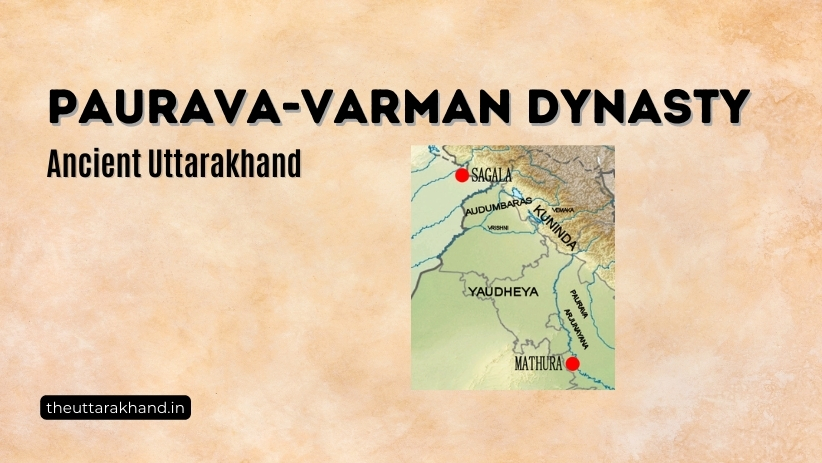
Paurava-Varman Dynasty in Ancient Uttarakhand : The Paurava-Varman dynasty ruled parts of Uttarakhand and Himachal Pradesh from around mid-4th century CE to early 7th century CE. They were descendants of the Guptas and ruled as feudatories, later asserting independence. This dynasty is known from inscriptions and copper plate grants issued by its rulers.
Key Points
- Originated as Gupta feudatories in mid-4th century CE
- Initially ruled parts of Garhwal and Kumaon regions as Gupta vassals
- Enjoyed autonomy and eventually asserted independence by early 6th century
- Ruled till early 7th century when displaced by the Khasas
- Important rulers include Nandivarman, Prithivi-Varman, Grahavarman, Medini-Varman
- Left behind copper plates, seals and coinage as historical evidence
- Patronized Hinduism, Buddhism and Jainism
- Promoted agrarian expansion and land grants
Origin as Gupta Feudatories
The Pauravas originated as feudatories and vassals of the Imperial Guptas in Uttarakhand. The Allahabad pillar inscription of Samudragupta mentions a king named “Asanga” ruling the mountains of Kumaon as a Gupta vassal in the mid-4th century CE. He has been identified as a member of the Paurava dynasty. The early Pauravas thus accepted Gupta overlordship and served as frontier rulers of their empire in the Kumaon-Garhwal Himalayas.
Consolidation under Nandivarman
The Pauravas began consolidating their rule under king Nandivarman in late 4th century CE. He is known from the Raghugumpha inscription of his descendant Prithivi-Varman II discovered at Baijnath. It describes Nandivarman as the son of Bhogavarman and founder of the kingdom. He probably achieved autonomy from the weakening Guptas and started ruling independently. He performed Vedic sacrifices to proclaim his sovereign status. His capital was located at Kartikeyapura (modern Baijnath). He patronized scholars and promoted the orthodox faiths of Hinduism.
Reign of Prithivi-Varman
Nandivarman was succeeded by his son, the powerful ruler Prithivi-Varman I. According to the Raghugumpha inscription, he uprooted his enemies and conquered several frontier kingdoms. These probably included petty Himalayan chiefdoms and lands previously under Gupta suzerainty. Through his military victories, Prithivi-Varman greatly expanded the boundaries of his kingdom. He assumed imperial titles like Maharajadhiraja to emphasize his paramount status. Prithivi-Varman also performed Vedic sacrifices and made land grants to Brahmins on ritual occasions. He promoted trade by improving roads and other infrastructure. After a long reign, he abdicated the throne in favour of his son Medini-Varman.
Medini-Varman
Medini-Varman enjoyed a prosperous reign characterized by general peace and stability. He focused on cultural activities and religious patronage. Medini-Varman repaired and renovated old temples. He also constructed a large artificial lake called Medinisagar after his name. It was filled during the rainy season and used for irrigation in summer. The king made extensive land grants to Brahmins and village assemblies on ceremonial gifting occasions. These helped expand agriculture in hitherto uncultivated areas. Medini-Varman ruled for many years before being succeeded by his son, Grahavarman.
Grahavarman
Grahavarman was another powerful Paurava monarch ruling in the first half of the 6th century CE. The Raghugumpha inscription describes his extensive military conquests against enemy kings and frontier tribes. Through his victories, Grahavarman enlarged his kingdom significantly by subduing autonomous hill chiefdoms. He assumed the title Maharajadhiraja to highlight his imperial status. Grahavarman was known for his religious tolerance and patronized Hinduism, Buddhism and Jainism equally. He repaired and renovated old shrines and temples while also constructing new ones. Like his ancestors, Grahavarman performed Vedic sacrifices and made land grants to Brahmins on ritual occasions. After a long and eventful reign, he abdicated the throne in favour of his eldest son, Prithivi-Varman II.
Decline and Fall
The last important Paurava ruler was Prithivi-Varman II who faced the rising threat from the Khasas or Khasiyas. These were hardy hill tribes who had started infiltrating the Himalayan region from Central Asia by 6th century CE. Prithivi-Varman fought against the Khasa leader Salasthamba and managed to defeat him. But subsequently, he was killed in a battle with another Khasa chief named Lalakhima. Prithivi-Varman II’s death around the early 7th century CE marked the end of Paurava rule as they were completely displaced by the ascendant Khasas. The dynasty faded away and the Khasas became the new political masters of Garhwal-Kumaon.
Administration and Culture
The Pauravas ruled through hereditary monarchies where power was passed from father to son. However, the kings followed an imperial model of administration developed during the Gupta period. The empire was divided into smaller administrative units like vishayas (districts) and bhuktis (provinces). There was a well-organized system of central and provincial government. Land revenue was an important source of income. The Pauravas also promoted trade and commerce. They maintained a standing army but also relied on feudal levies raised from tributary rulers and vassals.
Culturally, the Pauravas promoted a syncretic tradition assimilating Hindu, Buddhist and Jain elements. Their patronage led to development of art, sculpture, literature and temple architecture. The beautiful stone temples extant at Baijnath and Dwarahat were constructed under later Paurava rulers. Their eclectic model of rulership and syncretism influenced later dynasties of Garhwal-Kumaon like the Katyuris and Chand.
Evidence
The Pauravas have left behind coins, seals and around half a dozen copper plate inscriptions as evidence. The seals and plates were issued by kings to record land grants made to Brahmins and village bodies on religious ceremonies. These contain genealogical details, official titles of rulers along with fiscal and administrative information. The plates are written in Sanskrit using Gupta-era scripts like Box-Headed and Early Nagari. Stylistically, they are influenced by Allahabad pillar inscription of Samudragupta. The coins issued by Paurava rulers follow the Gupta prototypes in design and content. They often depict Hindu deities like Shiva, Vishnu or Goddess Lakshmi.
Some important Paurava inscriptions include:
- Raghu-Gumpha Prashasti (Baijnath plates of Prithivi-Varman II)
- Dwarahat plates of Prithivi-Varman I
- Gokarna plates of Grahavarman
- Tungnath plates of Prithivi-Varman II
These inscriptions and antiquities shed light on an obscure dynasty that once ruled the Central Himalayas before the medieval kingdoms of Garhwal, Doti and Kumaon emerged. They provide a missing link between the ancient and medieval periods in Uttarakhand history.
Conclusion to Paurava-Varman Dynasty in Ancient Uttarakhand
Paurava-Varman Dynasty in Ancient Uttarakhand : The Paurava-Varmans were an important transitional dynasty in the early medieval history of Uttarakhand. As Gupta feudatories, they helped maintain imperial control over the Kumaon-Garhwal region. They gradually consolidated power and their later rulers like Prithivi-Varman I and Grahavarman assumed sovereign status. At their peak, the Pauravas ruled over a large Himalayan kingdom stretching from Himachal to Nepal borders. They promoted agrarian expansion, land grants, trade and religious patronage. Their syncretic model of rulership influenced later medieval dynasties. However, the Pauravas could not ultimately withstand the Khasa tribal onslaught and faded away by 7th century CE. But they have left behind a significant epigraphic, numismatic and artistic legacy for modern historians to reconstruct their history.
FAQ’s on Paurava-Varman Dynasty in Ancient Uttarakhand :
Who were the Paurava-Varmans?
The Paurava-Varmans originated as feudatory vassals of the Imperial Guptas in 4th century CE before emerging as independent rulers in the Central Himalayas.
When did they rule Uttarakhand?
The Paurava-Varman dynasty ruled over parts of ancient Uttarakhand and Himachal Pradesh from around mid-4th century CE to the early 7th century CE.
Who were some important Paurava rulers?
Some important Paurava kings included Nandivarman, Prithivi Varman I, Grahavarman, Medini Varman and Prithivi Varman II.
What was their legacy and significance?
The Pauravas left behind inscriptions, coins and temples shedding light on early medieval Central Himalayas. Their model of rulership influenced later dynasties.