Governance and Political Structure in Udham Singh Nagar
Governance and Political Structure in Udham Singh Nagar
Governance and Political Structure in Udham Singh Nagar
Governance and Political Structure in Udham Singh Nagar : Udham Singh Nagar district is located in the state of Uttarakhand in India. The district has a robust administrative and political structure to govern the affairs of the region effectively.
Some key aspects covered in this article:
- Administrative divisions
- Rural and urban local bodies
- Key authorities and administrative units
- Political representation and elected bodies
- Ongoing governance initiatives
Administrative Divisions
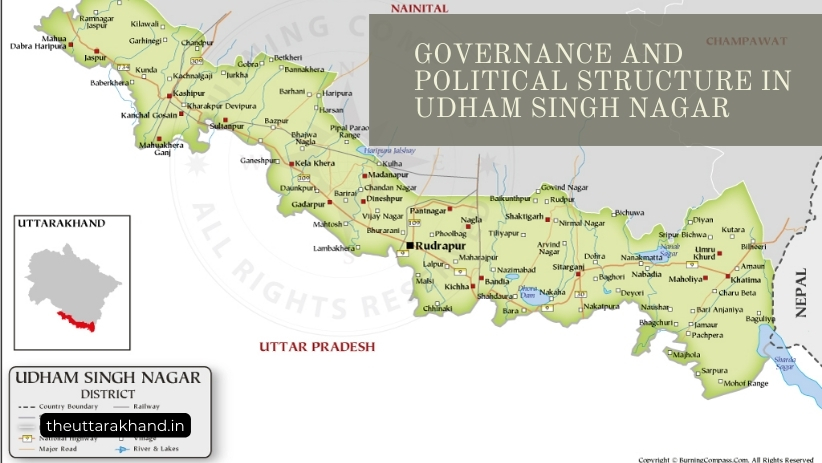
Udham Singh Nagar district has 5 subdivisions – Rudrapur, Kashipur, Bajpur, Gadarpur, and Jaspur. These subdivisions are further divided into smaller administrative units like tehsils, blocks, and gram panchayats.
Tehsils
There are 9 tehsils in the district – Rudrapur, Kashipur, Bajpur, Gadarpur, Jaspur, Sitarganj, Kichha, Khatima, and Nanakmatta.
The tehsildar is the key administrative officer for each tehsil. They oversee land records, revenue collection, law and order, disaster management, and various governance programmes.
Blocks
The district has 16 development blocks – Sitarganj, Nanakmatta, Khatima, Gadarpur, Jaspur, Kashipur, Bajpur, Rudrapur, Kichha, Bazpur, Mahuakheraganj, Shaktifarm, Dineshpur, Kalsi, Bahadrabad, and Roorkee.
Each block has a Block Development Officer (BDO) who heads the Block Development Office. The BDO coordinates the implementation of various government schemes and programmes at the block level.
Gram Panchayats
The rural areas of the district have around 1250 gram panchayats. Each gram panchayat comprises one or more villages and has an elected body headed by the Gram Pradhan.
The gram panchayats facilitate grassroots governance in the rural areas. They undertake activities like infrastructure development, delivery of public services, sanitation drives, etc.
Rural Local Bodies
As per the 3-tier Panchayati Raj system, Udham Singh Nagar has rural local bodies at the district, block and village levels.
Zila Panchayat
Udham Singh Nagar Zila Panchayat is the apex body that oversees the decentralized governance in rural areas of the district.
It has 56 elected members representing different blocks and subdivisions. The Zila Panchayat Adhyaksh is the elected head of this body.
Key roles:
- Approving annual budgets and expenditure
- Overseeing the functioning of Gram Panchayats and Block Panchayats
- Implementing centrally-sponsored and state schemes
Block Panchayats
There are 16 Block Panchayats in the district, one for each development block.
The Block Pramukh is the elected head of the Block Panchayat. They coordinate with the Gram Pradhans and oversee activities at village level.
Activities undertaken:
- Monitoring gram panchayat works
- Managing natural resources
- Implementing development activities
Gram Panchayats
Gram Panchayats are the basic units of decentralized governance in rural areas. There are around 1250 Gram Panchayats in Udham Singh Nagar district.
Each Gram Panchayat is headed by an elected Gram Pradhan and Ward members. They undertake grassroots governance activities in their respective villages.
Urban Local Bodies
For the administration of urban areas, the district has the following urban local bodies:
Municipal Corporations:
- Rudrapur Municipal Corporation
Municipal Councils:
- Kashipur Nagar Palika Parishad
- Sitarganj Nagar Palika Parishad
Nagar Panchayats:
- Bajpur Nagar Panchayat
- Gadarpur Nagar Panchayat
- Jaspur Nagar Panchayat
These urban local bodies are constituted under the Uttarakhand Municipal Act, 2016. They have an elected board of councillors headed by a Mayor/Chairperson.
Key roles and responsibilities:
- Civic administration and infrastructure development
- Delivery of essential services
- Tax collection and revenue generation
- Business regulation and licensing
- Urban planning and development
Key Authorities and Administrative Units
Some important governing authorities and administrative units in Udham Singh Nagar district are:
District Magistrate Office: Headed by the District Magistrate who is responsible for overall administration, law and order, regulatory functions, disaster management, etc.
Zila Panchayat: Headed by the elected Zila Panchayat Adhyaksh and oversees decentralized rural governance.
Chief Development Officer: Nodal officer for implementation of state and centrally sponsored schemes.
District Rural Development Agency: Headed by Project Director and implements programmes for poverty alleviation and rural development.
Various Line Departments: Such as education, health, agriculture, irrigation, police, transport, social welfare, etc. Each department has its own setup and roles.
Political Representation
Udham Singh Nagar district has 5 Vidhan Sabha constituencies and 1 Lok Sabha constituency representing it politically.
Vidhan Sabha Constituencies
The 5 Vidhan Sabha seats in the district along with their current representatives are:
| Constituency | Current MLA | Party |
|---|---|---|
| Rudrapur | Rajkumar Thukral | BJP |
| Kashipur | Trilok Singh Cheema | BJP |
| Jaspur | Adesh Chauhan | BJP |
| Bajpur | Yatishwaranand | BJP |
| Gadarpur | Arvind Pandey | BJP |
Lok Sabha Constituency
The Lok Sabha seat representing Udham Singh Nagar district is Nainital–Udhamsingh Nagar.
The current Member of Parliament is Ajay Bhatt of BJP who was elected in the 2019 Indian general election.
Ongoing Governance Initiatives
Some major governance initiatives currently ongoing in the district are:
Smart City Project: Focused on developing Rudrapur as a sustainable and citizen-friendly smart city.
Solid Waste Management: Several initiatives taken to manage solid waste scientifically in urban and rural areas.
Solar Power Projects: Promoting solar energy adoption through solar plants, rooftop installations, solar pumps etc.
Digital India Programme: Undertaking digital literacy drives and promoting adoption of digital payments.
Swachh Bharat Mission: Construction of household toilets and improving sanitation across the district.
Skill Development Programmes: Providing vocational training and skilling to make youth employable.
Conclusion to Governance and Political Structure in Udham Singh Nagar
Governance and Political Structure in Udham Singh Nagar : Udham Singh Nagar has a well-defined administrative structure aligned to the state norms. Both rural and urban areas have elected local bodies to facilitate decentralized governance.
While the district administration and line departments drive the overall development agenda, local self-governments like Panchayats bring governance to the grassroots.
With extensive political representation and ongoing governance programmes, the district is progressing well on social and economic development parameters.