Climate of Uttarakhand
Climate of Uttarakhand
Introduction to The Climate of Uttarakhand
The climate of Uttarakhand is sharply demarcated in its two distinct divisions: the predominant hilly terrain and the smaller plain region. The type of climate that is mainly found in the plains closely resembles the corresponding state in the Gangetic plain. Summers are exceedingly hot with temperatures crossing the 40°C mark and considerable humidity. Winters can be chilly with temperatures going below 5°C at times.
The climate in the northern part of Uttarakhand is typically Himalayan. This mountain range itself exerts an appreciable extent of influence on monsoon and rainfall patterns. Within the Himalayas, climate differs depending on altitude and position.
Key Highlights
- Climate ranges from subtropical to cool temperate based on altitude
- Monsoon from late June to mid September
- Winter snowfall from January to March
- Thunderstorms and hail in April-May
- Microclimates due to relief and altitude
Factors Influencing Climate
The climate of Uttarakhand is influenced by the following geographical factors:
1. Latitude
Uttarakhand lies in the warm temperate zone between 28°43’N and 31°28’N latitudes. This latitude facilitates pressure, wind circulation and inflow of extra-tropical disturbances during the winter.
2. Altitude
There is a sharp variation in altitude within the state from about 300 meters in the plains to Nanda Devi peak at 7,817 meters. The rise in altitude brings changes in temperature, precipitation etc.
3. Physiographic Features
The orientation of mountain ranges influences wind direction and precipitation. The slopes facing the monsoon winds receive heavy rainfall while rain-shadow areas exist as well. Local physiographic features also lead to formation of microclimates.
4. Upper Air Circulation
The state comes under the influence of westerly disturbances during the winter. These originate over the Mediterranean Sea and give rain/snow in the state. Monsoonal winds bring heavy rains during summer monsoon season.
Climatic Zones
Based on the altitude and associated climatic conditions, Uttarakhand can be divided into following climatic zones:
1. Sub-Tropical Zone
This zone lies at elevations up to 1,200 meters covering areas like Dehradun and Haridwar districts. Summers are hot with temperature around 30°C while winters are cool around 18°C.
2. Warm Temperate Zone
This zone lies between 1,200-2,400 meter altitude covering major valleys like Alaknanda, Mandakini etc. Summers are pleasant around 25°C while winters are cooler.
3. Cool Temperate Zone
Areas between 2,400-3,600 meters fall under this zone which covers higher valleys and slopes. Summers are cool around 15-18°C while winters are very cold with temperatures below freezing point.
4. Cold Alpine Zone
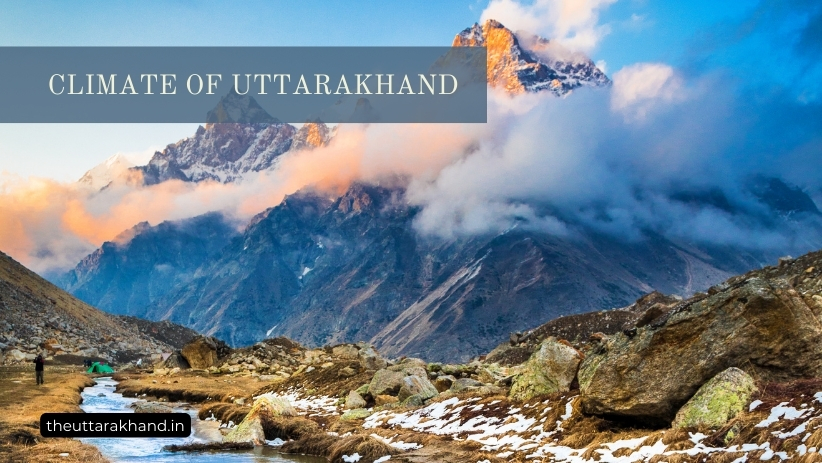
This zone lies above 3,600 meters encompassing higher Himalayan peaks and glaciers. Temperatures remain below freezing point throughout the year with perpetual snow cover.
Seasonal Variations
The climate of Uttarakhand has following distinct seasons during the year:
Summer Season (March – Mid June)
- Hot weather in sub-tropical plains with temperature touching 45°C
- Pleasant summer in hills with average 25°C temperature
- Pre-monsoon thundershowers and hailstorms in late May and early June
Monsoon Season (Mid June – September)
- Southwest monsoon brings widespread heavy rains
- 80% of annual rainfall received during this season
- Landslides and cloud bursts common during peak monsoon
Post Monsoon Season (October – November)
- Rainfall starts decreasing but high humidity persists
- Clear sky days increase offering excellent views of Himalayas
- Comfortable weather for tourism activities
Winter Season (December – February)
- Cold and dry weather under influence of northwestern disturbances
- Snowfall occurs at higher reaches blocking road routes
- Temperature drops below freezing point at night in higher hills
- Foggy mornings common in plains and valleys
Rainfall Distribution
The rainfall distribution in Uttarakhand has following distinct characteristics:
1. Sharp Gradient from North to South
There is a sharp decrease in rainfall from about 2,500 mm in north to about 1,200 mm in south. Areas like Pithoragarh and Chamoli receive very heavy rains while Haridwar and Dehradun receive relatively lower rainfall.
2. High Variation from West to East
The southern and eastern slopes of higher ranges receive very heavy rainfall exceeding 2,500 mm due to direct impact of monsoon winds. The northern and western slopes are rain-shadow areas receiving relatively lower rainfall.
3. Local Variations
Within small areas, the rainfall varies considerably based on orientation of valleys, local ridges and peaks. The localized relief features lead to significant micro-level differences.
Agro-Climatic Zones
For studying the climatic suitability of crops, Uttarakhand has been divided into following agro-climatic zones by the Uttarakhand State Agriculture Management & Extension Training Institute:
1. Bhabar and Tarai Zone
This zone covers Tarai area and Bhabar belt with elevation below 900 meters. The climate is sub-tropical with hot summer and cool winter. Paddy, wheat and sugarcane are major crops.
2. Western Himalayan Zone
This zone lies between 900-1,700 meters altitude encompassing Siwalik hills and Doon valley. Climate is sub-humid to humid with moderate summer and cold winter. Major crops are rice, wheat, maize, soybean etc.
3. North-Western Himalayan Zone
Areas between 1,700-3,000 meters altitude fall under this zone. The climate is cool with mild summer and severe winter. Major crops of the zone are wheat, paddy, finger millet, barley etc.
4. Great Himalayan Zone
This zone covers very high altitude areas beyond 3,000 meters encompassing peaks and glaciers. The climate is extremely cold with low vegetation cover. Limited agriculture is possible during short summer spanning July-August.
Microclimates
Despite being a small state, Uttarakhand exhibits significant climatic diversity across small geographical areas due to the complex relief and altitude variations. Some examples of microclimates are:
1. Valley Winds
The day and night temperature differential in valleys leads to formation of strong up-valley and down-valley winds. These winds greatly affect the localized temperatures.
2. Foehn Winds
These are warm and dry winds on the leeward side of the mountains formed when moist winds rise and cool adiabatically. It leads to marked increase in temperature during the winter months locally.
3. Winter Fog
In winters, radiation fog is formed in early morning hours in valleys and plains leading to very low visibility for few hours. This fog disappears with sunrise when heat increases.
4. Rain-Shadow Areas
Areas situated on rain-shadow side of high peaks receive very low rainfall as compared to windward side. This leads to sharp climatic contrast across two sides of the same mountain range.
Ecological Zones
The diverse climatic conditions across Uttarakhand facilitate existence of different types of ecosystems and ecological zones:
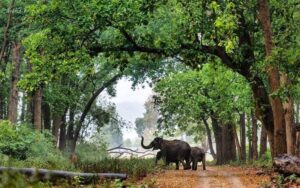
1. Tropical Moist Deciduous Forests
These forests exist in sub-tropical Bhabar region up to 900 meter elevation with Sal, Sissoo, Khair, Semal etc as main species. The climate is hot and sub-humid to humid.
2. Himalayan Sub-Tropical Pine Forests
Chir Pine is the dominant species between 900-1,700 meters elevation with sub-humid to humid climate and high rainfall. Broadleaf species like oak, rhododendron also exist with pine.
3. Himalayan Temperate Forests
Between 1,700-3,000 meters altitude zones, oak and deodar are the main tree species in these forests. The climate varies from warm sub-humid to cool humid.
4. Sub-Alpine and Alpine Forests/Pastures
These forests/pastures exist between 3,000-4,500 meters elevation encompassing fir, birch, rhododendron etc. The climate is extremely cold and humid.
5. Cold Deserts
Beyond snowline above 4,500 meters lies the zone of permanent snow, glaciers and cold deserts. Temperature remains below freezing and climate is extremely harsh.
Global Warming Impacts
The climate change due to global warming has started impacting Uttarakhand in following ways:
1. Glacier Retreat
Most glaciers in Uttarakhand Himalayas are retreating rapidly. According to a study, 468 glaciers have retreated by about 16% in last 50 years.
2. Temperature Rise
As per IMD data, the annual mean temperature has risen by 1.4°C in last 100 years in Uttarakhand with higher increase in winters.
3. Rainfall Variability
The monsoon rainfall data shows high inter-annual variation during last 30 years. The variability and extremes in rainfall have increased.
4. Floods/Droughts
The variable rainfall has increased incidence of droughts and floods. The 2013 disaster was also partly attributed to climate change factors.
5. Impact on Agriculture
With climate change, the crop suitability zones are shifting leading to changes in cropping patterns of farmers. Apple cultivation has also been impacted.
6. Biodiversity Impact
Many plants and animal species are under threat due to habitat loss from climate change. Medicinal plants have declined and invasive weeds increased.
Adaptation Measures
Following measures should be taken to adapt with the climate change effects:
- Vulnerability Assessment: Detailed studies on climate change exposure, sensitivity and adaptive capacity should be done for districts and local areas.
- Crops Diversification: Farmers should be educated to change cropping patterns and adopt alternate climate resilient crops.
- Forest Fire Management: With hotter climate, forest fires have increased and need better monitoring and control.
- Springs Revival: Drying springs should be recharged through trenches, contour bunds etc. New water sources need to developed.
- Disaster Preparedness: Better weather forecasting, warning systems and community preparedness is required to deal with extreme weather events.
Conclusion to The Climate of Uttarakhand
Despite being a small state, Uttarakhand has diverse climatic conditions due to extreme altitudinal variations and complex physiographic relief. The climate change due to global warming has started impacting the fragile mountain ecosystem. Concerted adaptation efforts are needed to build resilience of local communities that depend critically on natural resources for their livelihood. The sustainability of development process hinges on maintaining the vital ecosystem services through better management and governance.
FAQ’s:
What are the different climate zones in Uttarakhand?
Uttarakhand has subtropical, temperate, subalpine and alpine climate zones due to its location in the Himalayas and the variation in elevation.
What are the main seasons in Uttarakhand?
The main seasons are summer (March to June), monsoon (July to September), post-monsoon (October to November) and winter (December to February).
What kind of weather patterns occur?
Weather patterns include monsoons with heavy rain, winter snowfall in the mountains, fog and hail storms. Temperatures can vary widely.
How does climate change impact Uttarakhand?
Climate change leads to glacial melt, variable rainfall patterns, increased frequency of extreme weather events like floods and droughts, and threats to wildlife.