Himalayan Agriculture Unveiled: Cultivating Resilience in Challenging Terrain
The Himalayan region has nurtured unique agricultural systems to sustain human communities amidst geographical constraints. Indigenous practices, crops and livestock attest remarkable adaptation. However, commercialization, climate change and outmigration increasingly disrupt traditional farming. Balancing development and ecological stewardship is critical to safeguard the agricultural heritage of the Himalayas while improving rural welfare. With inclusive policies and support, these mountain communities can chart a path towards more sustainable livelihoods.
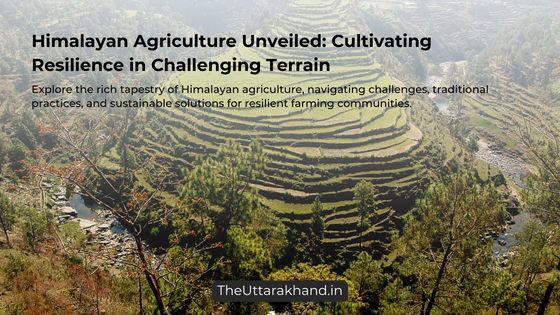
Himalayan Agriculture Unveiled Cultivating Resilience in Challenging Terrain
Himalayan Agriculture : The Himalayas, stretching over 1500 miles across South Asia, contain a diversity of agricultural practices and land tenure systems adapted to the region’s extreme elevations, slopes, and climate. This article examines farming and land ownership in the Indian Himalayas, covering the unique challenges posed by the mountain terrain, the predominant crops and livestock, and the evolution of land rights under different political regimes.
Introduction of Himalayan Agriculture
Himalayan Agriculture has always been constrained by scarce arable land, short growing seasons, and remoteness from markets. Yet mountain communities have developed resilient food systems based on terraced cultivation, crop diversity, pastoralism, and communal management of resources. Land tenure patterns reflect the transition from indigenous kingdoms to British colonial rule to post-independence land reforms. Today, climate change, outmigration, and commercialization increasingly impact traditional Himalayan agriculture and land relations.
Challenges of Mountain Agriculture
Several environmental factors pose difficulties for farming in the Himalayas:
- Steep slopes and landslides limit the area suitable for cultivation. Valley bottoms and terraced hillsides are the main farm sites.
- The growing season is restricted by early winter freezes and delayed spring thaws at higher elevations.
- Soil fertility is low in steeply sloping washed-out soils. Organic matter depletion is a concern.
- Rainfall varies greatly by location and altitude. Some areas are prone to droughts.
- Remoteness from markets increases costs of inputs and transportation.
Agricultural Practices
Despite these limitations, a variety of resilient agricultural practices have emerged.
- Terrace farming allows cultivation on steep hillsides by creating flat platforms reducing soil erosion and water runoff. Rice, wheat, millets, pulses, vegetables and fruits are grown.
- Agroforestry incorporates trees into farming systems, especially on terrace risers and boundaries. Trees provide fodder, fuelwood, timber, soil stability, and microclimate regulation. Common species are fodder trees like Grewia and Alnus nepalensis.
- Inter-cropping of compatible species optimizes productivity of small land parcels. Rice-wheat, maize-millet, or lentil-barley mixtures are common.
- Crop rotations improve soil fertility. Legumes are rotated with cereals.
- Pastoralism utilizes alpine meadows unsuitable for cropping. Yaks, sheep, and mountain goats provide meat, milk, wool, and transportation. Transhumance between valleys and high pastures continues.
- Off-season vegetables cultivated near permanent settlements provide income. Improved transportation enables commercial horticulture.
Major Crops
- Cereals: Rice, wheat, and millets like mandua and jhangora are dietary staples, supplemented by potatoes and pulses. Maize is expanding in warmer valleys.
- Cash Crops: Off-season vegetables, ginger, turmeric, temperate fruits, walnuts, spices, tea, coffee, and aromatic plants offer income generation potential.
- Food Legumes: Lentils, rajma, urad, horsegram.
- Horticulture: Apple orchards are a prominent commercial crop around Shimla. Other fruits include pears, peaches, apricots, almonds.
Livestock and Pastoralism
- Cattle: Local hill cattle provide milk and draught power. Crossbred cattle are increasing for milk productivity.
- Buffaloes: Buffaloes are kept for milk production in lower valleys.
- Goats and Sheep: Goats thrive on steep slopes and provide meat, milk and fiber. Sheep provide wool. Transhumance continues.
- Yaks: Yaks are reared for milk, meat, transportation, and fiber at high altitudes. They are crossed with cattle to produce zhomos.
- Horses and Donkeys: Equines provide transportation in valleys. Hybrid mules carry loads on mountain trails.
- Poultry: Chickens, ducks, turkeys and pigeons supplement diet with eggs and meat.
Traditional Land Tenure Systems
Indigenous land tenure patterns in the Himalayas were dominated by communal ownership and shared resource management. Key features included:
- Village lands were held collectively and allocated periodically to households based on size and needs.
- Forests, pastures and wastelands were community property and regulated by village institutions.
- Private property rights were limited to homesteads, orchards or terraced fields.
- Social hierarchies like caste influenced land allocation, often disadvantaging lower castes.
- Chiefs, kings or lamas controlled allotment in some areas like Kumaon, Lahaul and Ladakh.
- Transhumant grazing rights were shared between settled and nomadic communities.
- Irrigation systems were communally managed, including kuhl channels in Himachal.
- Usufruct rights rather than ownership were the basis of landholding. Lands could not be sold.
This communal framework aimed to distribute limited arable land equitably and regulate use of common resources through collective restraint. But inequalities and social barriers persisted.
Changes Under Colonial Rule
The British introduced private property rights and revenue administration. Key changes included:
- Communal lands were privatized and sold to tenants under permanent settlement systems.
- Revenue settlements fixed individual land tax liabilities, breaking communal ties.
- Forests were declared state property via Indian Forest Act of 1865. Village use was restricted.
- Common lands were appropriated for teak plantations or tea estates owned by British firms.
- Land became a commercial asset that could be bought, sold and mortgaged.
- These changes disadvantaged communities but enabled investment in commercial farming.
- Some collective management continued in Punjab hill areas, including shamlat grazing lands.
Post-Independence Reforms
After independence, land reforms aimed to boost productivity and reduce rural poverty. Key measures included:
- Abolition of intermediary tenures like zamindari and jagirdari systems in the 1950s-60s.
- Tenancy regulation and rights for sharecroppers, though implementation was limited.
- Ceilings on individual landholdings, with surplus distribution to landless laborers.
- Consolidation of fragmented holdings into viable farm sizes.
- Restoration of some common lands to village community management, as in Uttarakhand.
However, the success of reforms was mixed. Inequities persist due to poor implementation, tenancy evasion and social barriers. But food production expanded through Green Revolution technologies in the 1960s-70s.
Contemporary Issues of Himalayan Agriculture
Today, new challenges are impacting the Himalayan agricultural economy and land tenure patterns:
- Climate change is reducing farm productivity and threatening food security. More extreme weather, shifting monsoon patterns, glacial retreat, and water scarcity jeopardize crops and livestock.
- Outmigration and abandonment of marginal farms is increasing due to lack of profitability. Urbanization pulls youth to cities for jobs.
- Commercial pressures and market integration are transforming subsistence farming. High-value horticulture for urban markets expands through contract farming.
- Infrastructure development like roads and hydropower projects displace farmers from lands. Compensation and rehabilitation are inadequate.
- Privatization and land sales erode communal tenures. Absentee ownership and speculative investment in farmland grow.
- Inequities persist due to elite capture of benefits. Women and marginalized groups still lack land rights.
Sustainable solutions require strengthening community tenure, climate adaptation, inclusive policies, and programs to support smallholder farmers. Agro-ecology, diversification, and adding value locally can enhance rural livelihoods. Equitable land reforms remain critical for poverty alleviation in the fragile but vital Himalayan hill economies.
Conclusion of Himalayan Agriculture
Himalayan Agriculture : The Himalayan region has nurtured unique agricultural systems to sustain human communities amidst geographical constraints. Indigenous practices, crops and livestock attest remarkable adaptation. However, commercialization, climate change and outmigration increasingly disrupt traditional farming. Balancing development and ecological stewardship is critical to safeguard the agricultural heritage of the Himalayas while improving rural welfare. With inclusive policies and support, these mountain communities can chart a path towards more sustainable livelihoods.