Himalayan History Unveiled: Kingdoms, Empires, and Modern Geopolitics
The Himalayas have witnessed a long, complex political history involving local kingdoms, empires, colonial powers, and modern nation-states. Strategic location made the region pivotal in power struggles from ancient to modern times. While prone to outside influences, the Himalayas’ cultural heritage survives, interwoven with the area’s dramatic geography. Going forward, balancing development and conservation will be critical for these majestic yet fragile mountain landscapes.
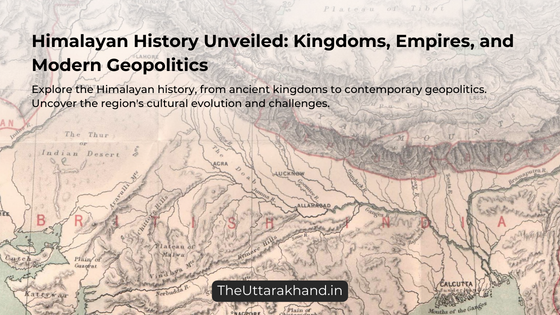
Explore the rich tapestry of Himalayan history, from ancient kingdoms to contemporary geopolitics. Uncover the region's cultural evolution and challenges.
Himalayan History : The Himalayan mountain range stretches over 1,500 miles across South Asia, encompassing a diverse region politically divided between India, Nepal, Bhutan, Pakistan, Afghanistan, and Tibet. This article provides an overview of the major rulers, kingdoms, and empires that have governed the Himalayan districts throughout history.
Early Kingdoms of Himalayan History
Some of the earliest known political entities in the Himalayas emerged in the 6th century BCE. In the western Himalayas near present-day Kashmir, the Gandhara kingdom was founded, controlling trade routes between India, Persia and Central Asia. Further east, smaller hill kingdoms like the Koli state in Kumaon exercised local control.
In the 4th century BCE, the Maurya Empire rose to prominence in northern India and brought many Himalayan kingdoms under its domain as vassal states. After the decline of the Mauryas in the 2nd century BCE, the region saw incursions by Indo-Greek, Saka, Kushan and Huna peoples migrating from Central Asia. Between the 7th-15th centuries CE, distinct regional kingdoms formed across the central Himalayas, like the Malla kings in Nepal and the Chogyal monarchy in Sikkim.
Medieval States
In medieval times, several Himalayan kingdoms became prominent due to their control of trade routes. The Karkota dynasty ruled Kashmir from the 8th-9th centuries and built significant temples and monasteries. In the 12th century, Tibetan influence expanded over Ladakh, Sikkim and Bhutan as Tibetan Buddhism spread.
The Malla kings continued ruling the Kathmandu Valley and surrounding areas in Nepal until the late 18th century. Also in the 18th century, the Gorkha Kingdom emerged as a major power in western Nepal. The Gorkha ruler Prithvi Narayan Shah embarked on a campaign of conquest, subjugating neighboring kingdoms and eventually forming modern-day Nepal.
Rise of the Sikh Empire
In the northwest Himalayas, the Sikh Empire rose to prominence in the early 19th century, capturing territory from Afghan and Mughal rulers. The empire’s founder Maharaja Ranjit Singh secured control over Jammu and Kashmir regions. After Ranjit Singh’s death, the Sikh Empire fell to the British forces in 1849 after the Anglo-Sikh Wars.
British Colonial Era
Beginning in the late 18th century, the British East India Company began making inroads into Himalayan kingdoms to secure strategic hill stations and access to Tibet. This brought them into conflict with Nepal, resulting in the 1814-1816 Anglo-Nepalese War in which Nepal lost significant territory. Kashmir also came under British control after the First Anglo-Sikh War in 1846.
Following the 1857 rebellion, the British Raj assumed direct control over most Himalayan regions in present-day India and Pakistan through colonial administrative divisions like the North-Western Provinces. Remote mountainous areas maintained indirect governance. Princely states like Jammu and Kashmir, Chamba, Kullu, and Tehri Garhwal retained local rulers under British suzerainty.
Independence and Partition
The partition of British India in 1947 divided the Himalayas between the new nations based on religious demographics and strategic priorities. India retained most southern Himalayan districts in Himachal Pradesh, Uttarakhand, Sikkim, and Arunachal Pradesh. Pakistan secured control of Gilgit-Baltistan and Azad Kashmir.
Existing princely states like Jammu and Kashmir, Chamba, Mandi, and Tehri Garhwal had to choose accession to India or Pakistan. The Hindu maharaja of Kashmir opted for India, precipitating the first Indo-Pakistan war in 1947-48 and the ongoing dispute over Kashmir. Smaller states joined India. Sikkim was an Indian protectorate until annexed in 1975. Bhutan and Nepal preserved independence, but India still exerts major cultural and political influence.
China gained control of Tibet in 1950. The 1962 Sino-Indian war was fought over disputed boundaries, especially Aksai Chin bordering Kashmir, claimed by India but occupied by China. Border tensions remain, exemplified by the 2017 Doklam standoff between Indian and Chinese forces on the Bhutan border.
Modern Developments of Himalayan History
Independence and partition transformed the geopolitics of the Himalayan region. India, Pakistan, and China consolidated administration and military presence, building roads to frontiers and disputed areas. These enabled exploitation of natural resources, hydropower development, and tourism, but also greater environmental degradation.
Mass tourism emerged in the late 20th century, especially religious tourism to pilgrimage sites. Hill stations established by the British continue as popular destinations. Trekkers are drawn to Nepal’s Annapurna Circuit and the Indian Himalayas. Mountaineering and adventure tourism expanded greatly after 1950.
Despite modernization, the Himalayas retain exceptional cultural diversity, ecological richness, and geopolitical significance, on the frontiers of India, Pakistan, China and Nepal. Environmental protection and sustainable development remain key challenges for the future of Himalayan History.
Conclusion of Himalayan History
Himalayan History : The Himalayas have witnessed a long, complex political history involving local kingdoms, empires, colonial powers, and modern nation-states. Strategic location made the region pivotal in power struggles from ancient to modern times. While prone to outside influences, the Himalayas’ cultural heritage survives, interwoven with the area’s dramatic geography. Going forward, balancing development and conservation will be critical for these majestic yet fragile mountain landscapes.