History of Uttarakhand: Garhwal and Kumaon Through the Ages
History of Uttarakhand
History of Uttarakhand
History of Uttarakhand : Uttarakhand, located in the Himalayan foothills of northern India, has a long and storied history. Once comprised of over 50 small kingdoms, the region was unified in the medieval era under the Garhwal and Kumaon kingdoms. Over the centuries, Uttarakhand has seen rule by major empires like the Guptas, Kushanas, and Mauryas, as well as the British Raj.
Ancient Period
The ancient history of Uttarakhand is shrouded in mystery. According to Hindu legends, the region was once inhabited by gods and demons. Archaeological evidence indicates early human settlement since prehistoric times:
- Stone tools dating back to lower Paleolithic era found in Uttarakhand valleys
- Rock paintings and stone structures indicating human presence in 6th-4th century BCE
- Remains of Northern Black Polished Ware culture (700-100 BCE) discovered
The region was likely settled and traversed by early Indo-Aryan tribes migrating from the northwest. By 500 BCE, present-day Uttarakhand fell on trade routes linking Tibet and India.
Advent of the Mauryas
Uttarakhand first entered recorded history under the Maurya Empire (4th-2nd century BCE). The Mauryan king Ashoka erected pillars and rock edicts across his realm to spread Buddhist teachings. Several Ashokan inscriptions have been found in the Kumaon division of Uttarakhand.
Medieval Era: Rise of Garhwal and Kumaon
After the Mauryas, Uttarakhand was ruled by local chieftains and dynasties like the Kunindas. From the 6th to 11th centuries CE, major kingdoms like the Kushanas, Guptas, and Gurjara-Pratiharas exercised control over the mountainous region.
Emergence of Small Hill Kingdoms
After the decline of the Gurjara-Pratiharas around 1000 CE, Uttarakhand dissolved into a cluster of tiny hill kingdoms ruled by local clans. By the 13th century, the Garhwal and Kumaon regions emerged as the foremost principalities.
History of Uttarakhand : Unification of Garhwal
The small hill chiefdoms of western Uttarakhand were unified under the Panwar Rajputs by the mid-13th century. The Panwar ruler Ajay Pal conquered neighboring kingdoms and founded the Garhwal Kingdom, establishing his capital at Srinagar.
Kumaon under the Chands
Eastern Uttarakhand was unified under the Chand dynasty, who originated near Pithoragarh. The prosperous Chand Kings ruled Kumaon for over two centuries (12th to 14th century CE) from their fortified capitals like Karnaprayag and Champawat.
Medieval History
History of Uttarakhand : From the mid-14th century onwards, the Garhwal and Kumaon kingdoms were engaged in constant warfare as they vied with each other for regional supremacy.
Rise of the Shah Dynasty
In the early 15th century, the Panwar ruler of Garhwal was overthrown by Ajai Pal, the founder of the Shah dynasty. For over two centuries, the Shah kings fought to expand Garhwal territory at the expense of neighboring Kumaon and plains kingdoms.
Kumaon-Garhwal Rivalry
The Chand kings were replaced by the Malla dynasty in Kumaon, leading to a prolonged struggle between the Mallas and Shahs. By the 17th century, repeated invasions by the Mughals of Delhi had significantly weakened both kingdoms.
Gurkha Conquests
In the early 19th century, the Gurkha kingdom of Nepal exploited the discord in Kumaon and Garhwal to launch a series of invasions. By 1803, the Gurkhas overran almost all the hill kingdoms of Uttarakhand. Their oppressive rule was marked by heavy taxation, plunder, and repression.
History of Uttarakhand : British Rule
Facing a Gurkha invasion, the East India Company entered into an alliance with Kumaon and Garhwal chiefs to drive out the Nepalese. After the Anglo-Gurkha War (1814-1816), major parts of Uttarakhand came under British control.
Early Administration
Initially, the British administered Garhwal and Kumaon as part of the North-Western Provinces. After 1837, the region was constituted as a distinct district named Kumaon Division, with headquarters at Almora.
Impact of British Rule
Under the British Raj, roads were constructed linking the Uttarakhand highlands with the plains. This led to in-migration from the plains and commercialization of agriculture. While famines and poverty remained issues, the British abolished oppressive taxes and bans imposed by the Gurkhas.
Growth of Towns
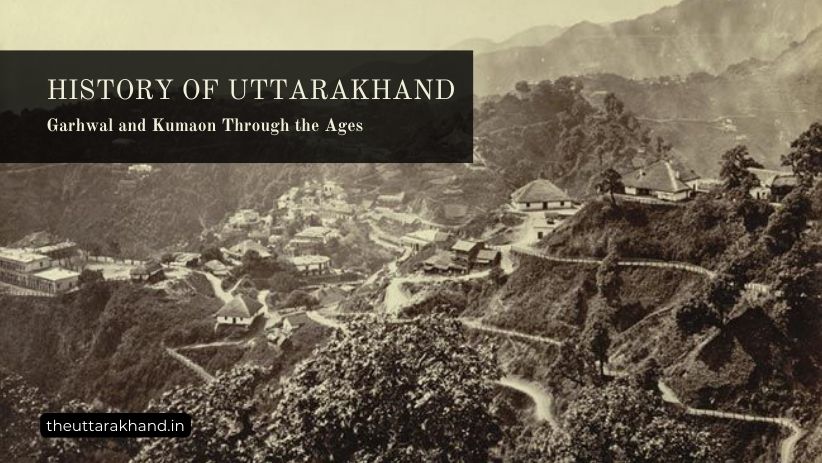
The hill stations of Mussoorie and Nainital emerged as monsoon capitals and tourist destinations during British rule. The townships of Srinagar and Pauri also grew as British administrative centers. By the early 20th century, the railheads of Dehradun and Kathgodam connected Kumaon and Garhwal to the North Indian transport network.
Independence Movement
People from present-day Uttarakhand played an active role in India’s struggle for independence. Prominent freedom fighters from the region include:
- Govind Ballabh Pant – Premier of United Provinces, key member of Congress national leadership
- Anusuya Prasad Bahuguna – Leader of Chipko movement of peasant resistance
- Indramani Badoni – Revolutionary involved in Kakori conspiracy
- Jayaprakash Narayan – Socialist leader and independence activist
Post-Independence
After India’s independence in 1947, demands grew from Uttarakhand’s leaders for separation from Uttar Pradesh and statehood.
Uttarakhand Statehood Movement
Citing neglect from the UP government and need to preserve cultural identity, political parties in Uttarakhand launched agitations demanding full statehood. In 2000, the Uttarakhand Kranti Dal party launched a massive movement for statehood.
Formation of Uttarakhand
Due to the sustained statehood movement, the Uttaranchal state was carved out of northwest UP in 2000. It was renamed Uttarakhand in 2007. Dehradun was designated the interim capital, which continues to be the state’s political center.
History of Uttarakhand
History of Uttarakhand : Uttarakhand has passed through many historical eras – from isolated hill chiefdoms to unified Garhwal and Kumaon kingdoms, the autocratic rule of the Gurkhas, the modernizing British Raj, and finally statehood within the Indian republic. Through the vicissitudes of history, the hardy hill folk of Uttarakhand have retained their distinct cultural identity shaped by the mountains.
FAQs about History of Uttarakhand
Q: When was Uttarakhand established as a state?
A: Uttarakhand became an official state of India in 2000 after separating from Uttar Pradesh.
Q: Who were early rulers of the Garhwal and Kumaon regions?
A: Some early dynasties ruling Garhwal and Kumaon included the Katyuris, Chands, Panwars, and local rajas.
Q: What happened to Uttarakhand during British rule?
A: The British annexed parts of Garhwal and Kumaon in the early 19th century after defeating the Gorkhas. The regions were part of British India until independence.