Agriculture and Allied Sector in Uttarakhand
Agriculture and Allied Sector in Uttarakhand
The Importance of Agriculture and Allied Sector in Uttarakhand
Agriculture and Allied Sector in Uttarakhand, Like many parts of India, agriculture plays a significant role in the Uttarakhand economy with 70 percent of the rural population engaging in this sector for their livelihoods. Poor infrastructure and lack of alternative means of livelihood have led a majority of people to be dependent on agriculture for their incomes and subsistence.
Key Highlights of Agriculture and Allied Sector in Uttarakhand
- 70% of rural population in Uttarakhand depends on agriculture
- Uttarakhand is an important producer of non-seasonal vegetables like peas, potatoes, cabbage etc.
- Large number of orchards in Uttarakhand produce various fruits like apples, pears, litchi etc.
- Local production of fruits has stimulated growth of a large processing industry in the state
- 89% of agricultural holdings fall under small and sub-marginal category
- Scale of economies cannot be availed due to small land holdings, leading to higher input costs per unit output
- Soil of Tarai region is very fertile but indiscriminate use of chemicals and overexploitation of groundwater makes it less fertile
- Hill region is prone to soil erosion due to steep slopes, making it less fertile
- Most agriculture is rainfed. Net irrigated area stands at only 3.38 lakh hectares
- Only 47% of net sown area is irrigated, mostly in plains and valleys
- There is a need to increase net irrigated area through rainwater harvesting, check dams etc.
- Technologies like drip irrigation and sprinklers can improve water management
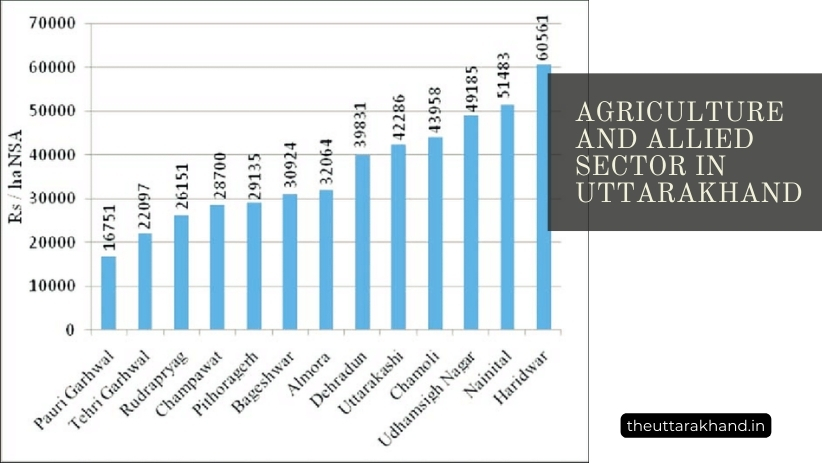
- Productivity is high in districts like Udham Singh Nagar, Haridwar, Nainital (plain) and Dehradun (plain)
- Productivity is very low in hilly districts, though valleys are fertile
- Plains agriculture is highly productive but hill agriculture lags far behind
- Green Revolution benefitted farming in plains but neglected hilly region
Status of Agriculture in Uttarakhand
Out of the total area in Uttarakhand spanning over 53483 sq km, the net sown area is 7.01 lakh hectares, which is only 14.7% of the total reporting area. About 89% of agricultural holdings in the state fall under the small and marginal category.
Land Holdings
As a large number and area fall under small and marginal holdings, economies of scale cannot be achieved, leading to higher input costs per unit of output.
The soil of the Tarai region is very fertile and supports a number of crops. However, indiscriminate use of chemicals and overexploitation of groundwater makes the soil in this region less fertile, causing a reduction in sustainability and productivity.
On the other hand, the hill region is prone to constant soil erosion due to steep slopes, making it less and less fertile over time. This can only be addressed through adoption of better management practices.
Agricultural Practices
In the state, farmers generally follow two types of agricultural practices:
- Rainfed
- Irrigated
Most agriculture in the state is rainfed. The net irrigated area of the state stands at only 3.38 lakh hectares (2009-2010). The percentage of net irrigated area to net sown area for the state is 47%. Since a large area lies under hills, irrigation is available mostly in the plains and valleys.
So there is a need to generate alternate sources of irrigation to increase the net irrigated area, which in turn shall also increase the cropping intensity of the state. These alternative sources can include:
- Rainwater harvesting
- Check dams
- Hydrams for lift irrigation etc.
Technologies like drip irrigation and sprinklers can also be used for better water management.
Growth Trends
The growth of food grain production is quite variable in different areas. As a result, the agriculture scenario presents a mixed picture.
Productivity of districts like Udham Singh Nagar, Haridwar, Nainital (plain) and Dehradun (plain) is very high. On the other side, productivity of the hilly areas is very low, although the valleys are fertile.
Plains and hill agriculture stand in stark contrast to each other:
- While productivity in plains can be compared with agriculturally developed regions of the country, productivity in hills lags far behind.
- The Green Revolution benefitted the farming system of the plain areas of the State while it neglected the hilly region.
Opportunities
Besides the threats, there are ample opportunities for increasing production and productivity, especially in pulses and oilseeds. This can be achieved by:
- Utilizing cultivable wasteland
- Better managing land and water resources through practices like rainwater harvesting
- Organic farming
- Diversification of agriculture
- Post-harvest technologies
- Strengthening market interventions
- Use of farm machinery
These measures can make agriculture a more profitable occupation.
Percentage of Agricultural Workers
The percentage of agricultural workers in the total workforce of Uttarakhand was 58.4% in 2011. This was similar to the all-India proportion of 58.2% for agricultural workers.
While at the country level, male agricultural workers comprised around 61% of total workers, female workers were much lower at 39%. However, in Uttarakhand, female workers in agriculture (52.2%) were a larger proportion than their male counterparts (47.8%). This establishes that agriculture provides subsistence employment especially for women in the state.
Major Crops
The major food crops cultivated in Uttarakhand are paddy, wheat, barley, maize, ragi and small millets. Cash crops like sugarcane and oilseeds and potato are also grown in substantial quantities. The state is also known for its horticultural crops, which include fruits like apples, oranges, pears, peaches, litchis, etc.
The productivity of major crops is given below:
| Crop | Productivity (kg/ha) |
|---|---|
| Rice | 1,898 |
| Wheat | 2,340 |
| Maize | 1,781 |
| Barley | 1,345 |
| Potato | 17,143 |
Allied Activities
Allied activities like horticulture, livestock, beekeeping etc. are more profitable than some agricultural activities. This points towards the need for diversification in the state.
Horticulture can become an impressive tool for:
- Promoting development in hilly areas
- Raising farmer incomes beyond subsistence levels earned from traditional crops
Suggestions for Agriculture and Allied Sectors
Here are some suggestions for developing the agriculture and allied sectors in Uttarakhand:
Key Suggestions
- Land consolidation (Chakbandi) and cluster farming
- Universalization of schemes rather than restricting them to only scheduled castes and tribes
- Setting up seed and fodder banks
- Local preservation centres for perishable farm products
- Ensuring easy accessibility of credit and local farmer markets
- Promoting organic farming and branding of organic products
- Including crop losses due to animals under insurance
- Solar pumps for lifting water to high altitudes
- Focus on mushroom production and bee keeping
- Exposure visits for farmers to learn new techniques
Other Detailed Suggestions
- Processing units for perishable items should be established in local areas to minimize transportation costs
- Loss of crops due to animal attacks should be covered under crop insurance schemes
- Install solar pumps for lifting water to high altitudes
- Increased focus on mushroom production and bee keeping
- Regular exposure visits of progressive farmers outside the state, to learn new techniques, especially for hill farming
- Revolving fund of Rs. 10 crore created by state government in 2019 for farmers in hilly areas growing conventional crops like Madua, Jhangora etc.
- Promotion of farmer producer organizations (FPOs) to engage in marketing and selling farm produce
Agricultural Development: Scenario and Constraints
Enhancing productivity is one of the most important challenges for Uttarakhand because of difficult terrain, infertile soils, cold climate and other constraints.
Most agricultural development efforts in the hills have been designed without properly understanding the unique hill conditions, resources, environment and socio-cultural settings.
Key constraints include:
Soil Health
In both hilly and plain areas, soil health is a major concern:
- Shallow, coarse texture in hills leads to erosion
- Regular landslides and deforestation worsen soil loss
- Steep slopes make farming difficult, harming soil stability and productivity
Lack of Irrigation
Geographical limitations constrain irrigation facilities, especially in hills:
- Half of the cultivated land is not irrigated
- Major sources are tube wells and canals
- Poor farmers can’t access new machines and equipment
- Lack of knowledge and resources leaves lands barren
Fragmented Landholdings
- Large proportion of marginal and small farmers
- Fragmentation and poor economic status leads farmers to subsistence farming and low yields
- 36.27% of land holdings are between 0.5-1 hectares in size
- Many farmers have shifted to horticulture, livestock etc.
Migration
- Migration from hills to plains due to lack of basic infrastructure – electricity, roads, irrigation, healthcare etc.
- Leads to farmlands being abandoned and no crop production
Other Challenges
- Crops destroyed by monkeys, pigs, insects, pests etc.
- Landslides
- Lack of quality seeds and fodder
- Transportation and marketing problems
- Lack of market information leading to distress sales
Crop Insurance
Evidence suggests animal attacks and natural disasters as important reasons for crop loss in Uttarakhand:
- High proportions of crop loss due to animal damage reported in districts like Rudraprayag (93.2%), Chamoli (81.1%), Bageshwar (90%)
- But crop insurance proportions very low in these same districts – Rudraprayag (28.6%), Chamoli (9.8%), Bageshwar (11.9%)
- Majority of households in hill districts reported crop losses due to animals and natural causes
Key Policies and Schemes
Various policies and schemes have been implemented by the Uttarakhand government to promote agriculture and allied sectors:
Jamindari Abolition Act 2019
- Allows leasing up to 30 years of unused agricultural wastelands to individuals, organizations and societies
- For activities like cultivation, horticulture, livestock rearing, fruit processing etc.
Agriculture Development Scheme
- Promotes activities like apple cultivation, lemon grass, ginger, turmeric, medicinal plants, animal husbandry, fisheries etc.
Public Private Partnership (PPP) Policy 2019
- PPP cells to identify and implement projects, expedited approvals
- Investments up to Rs. 5 crore approved by PPP Finance Committee
- Investments between Rs. 5-50 crore approved by Expenditure Finance Committee
Specially Abled Equal Opportunities Policy 2020
- Insurance schemes for differently abled
- Making government buildings disabled-friendly
- Survey to monitor development of disabled children
- 5% reservation in government jobs
Other Schemes
Some other schemes include:
- Anchal Amrit Yojana – Milk provision for children at anganwadi centers
- State Pirul Policy – Managing pine needles through collection, compressed forms etc.
- Twenty Point Programme – For poverty alleviation, agriculture growth, food security, rural infrastructure etc.
Conclusion to Agriculture and Allied Sector in Uttarakhand
Agriculture and Allied Sector in Uttarakhand, Agriculture is the mainstay of Uttarakhand’s economy and provides subsistence to a majority of the state’s rural population. However, low productivity and growth remains a key challenge. There is an urgent need to focus on sustainable development through measures like organic farming, diversification into horticulture and allied activities, adoption of new technologies and equipment, investments in infrastructure, strengthening of supply chains and access to credit and insurance. The difficult geographical terrain and poor connectivity of hilly districts needs special policy attention. With the right mix of political will, policies, investments and grassroot-level focus, the full potential of agriculture and allied sectors can be realized for the socio-economic progress of rural Uttarakhand.
FAQs on Agriculture and Allied Sector in Uttarakhand:
What is the importance of agriculture in Uttarakhand?
Agriculture plays a significant role with 70 percent of the rural population engaging in this sector for their livelihoods.
What are the major agricultural products of Uttarakhand?
The state is an important producer of non-seasonal vegetables, fruits like apples, pears, litchi etc. and commercial crops.
What are the challenges faced by agriculture sector in the state?
Difficult terrain, infertile soils, lack of irrigation, small landholdings, lack of modern techniques and crop damage by animals.
What is the scope for improvement?
Encouraging horticulture, organic farming, diversification into allied activities, improving marketing and infrastructure.